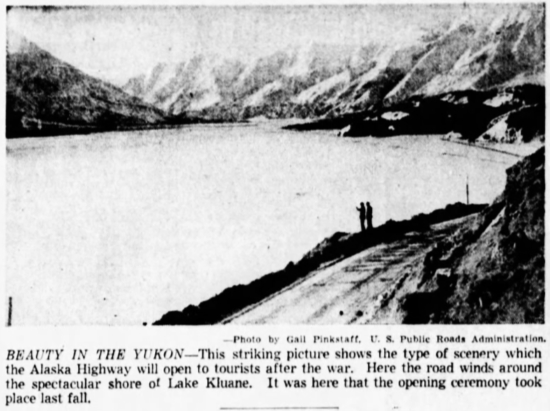
WHITE HORSE, Y.T., May 22. - Some of the most picturesque aspects of the early construction of the Alaska Highway have just been disclosed by Brigadier-General Clarence L. Sturdevant, assistant chief of the United States Army Engineers, who organized and mobilized the regiments which did the job.
Gen. Sturdevant said that at first it was thought impossible to build the road along a direct route between Watson Lake and White Horse.
All the available maps made it seem as if the highway would have to swing in a great loop via the Dease River, Telegraph Creek and Atlin. This would have increased the length of the road by nearly 500 miles, a staggering addition in terms of gasoline, effort and trucks.
However, airplane reconnaissance came to the rescue. A route over the mountains was discovered entirely in forest growth, which does not thrive higher than 4000 feet in the northern latitudes.
"This route," said Gen Sturdevant, "was apparently unknown to any of the local inhabitants and its discovery was an important factor in the early completion of the road."
LEAP FROG SYSTEM.
Gen. Sturdevant also described for the first time in detail exactly how the road was shoved, pushed and forced through the British Columbia and Yukon fastnesses.
"In a typical operation of a regiment engaged in breaking new trail through the forest," he said, "we would find in the lead the locating party, which
indicated the centre line by blazes or pieces of colored cloth.
"The clearing crew with three shifts of tractor operators followed. One large bulldozer ran along the marked centre line clearing a narrow trail. Other large machines were then assigned tasks along this trail.
"Pushing the trees laterally to both sides, they made a clearing from 60 to 90 feet wide. Having finished a task, a bulldozer would leapfrog forward to its next
similar task.
THREE MILES A DAY.
"On much of the route the forest growth was dense but the trees were usually not large or deeply rooted. Where the ground was firm, 10 or 12 bulldozers could clear two to three miles through solid forest each day.
"The smaller bulldozers were used to follow the large tree movers cleaning off moss, muck and lesser debris.
"The clearing crew was generally several miles beyond the reach of trucks and had to be supplied by pack horses or tractor-drawn sleds. The men slept in pup tents and moved camp nearly every day."
"SOFTNESS" DISPROVED.
Brig.-Gen. James A. O'Connor, head of the U.S. Army Northwest Service command, said the punching through of the original road was as much a frontier enterprise as the expeditions of Lewis and Clark, Alexander Mackenzie and Simon Fraser.
"Whenever I hear someone say that our present generation of boys is soft, I think of the young Americans from every walk of life who bulldozed that road through the wilderness in less than a year."
In addition to the completion of the Alaska Highway, the Northwest Service Command is supervising the construction this spring and summer of an auxiliary road from Haines on the Inside Passage to Champagne on the main highway. Champagne is 108 miles northeast of White Horse.
Colonel Kenneth B. Bush, service command chief of staff, has announced that this feeder route will be known officially as "The Haines Military Road."
"This additional highway from the seacoast," Col. Bush said, "will connect southeastern Alaska with the Alaska Highway, it will relieve any threat of congestion on the White Pass and Yukon Railway at Skagway, and it will enable water traffic to come up the inside passage from Seattle, Vancouver and Prince Rupert and be loaded directly onto trucks for the haul into Fairbanks and the interior of Alaska."