This article was originally published in The Yukoner Magazine #15 (July 2000)
Historians can be a bookish lot, working in obscurity in our universities and government offices. Their work is important to Canadians as we define ourselves and
project our image abroad.
If there were "historian superstars", the Yukon could lay claim to
a home team that is full of them. We have Ken Spotswood, Jim Robb, Roy Minter, Flo Whyard, team captain Pierre Berton and many others.
But there are even more. There are others who have unique ways to
promote the north. And just because they don't deal in cold facts with an authoritative delivery, many Yukoners and visitors do not consider them "historians".
They are the unappreciated and the unrecognized historians of the
Yukon.
They make the cold facts easy to find and easier to understand. They entertain us with our own history. They let us touch our history with crafted momentos. And they pull all of the facts together in a humourous snapshot.
Please take notice of these other valuable members of the team.
* * * * * *
It all started with his love of the north. He is now the Internet's "Northern Ambassador".
As a 10-year-old, Murray Lundberg would tape Robert Service poems to his bedroom walls. A job in a mine 15 years later, in Stewart, BC, showed him just how interesting northerners could be. They tend to have a wide range of experiences and seldom get in a rut.
And the scenery... the north has it all. Ancient glaciers and majestic mountains, historic rivers and secluded lakes, endless forests and northern lights.
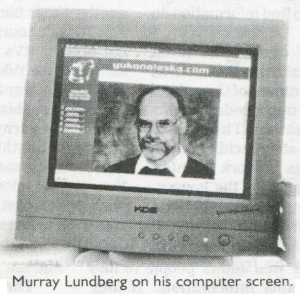 The only reason Murray is the host to 20,000 World Wide Web surfers everyday, is because it is the most efficient method to show off his beloved home to the world.
And it is not enough to encourage tourists to visit. He wants them to leave the downtown cores and their modern hotels to see the real Yukon. Drive for one hour in any direction from any town and they can pitch a tent beside a rambling river and allow the "magic and the mystery" to slowly soak in.
Or they can escape from the tour bus driver for a night and talk
to some real Yukoners.
Murray also wants the world to learn the truth about the north. Not just Canada's north, but the entire northern circumpolar region. As one of 800 expert guides with "About.com", Murray shows Web surfers where to find authentic and useful information about his specialty - the north.
His two gateways - canadafarnorth.about.com and arcticculture.about.com - allow potential tourists, students and northern enthusiasts to access Web sites he has personally vetted for content. Along with his own gateway - yukonalaska.com - Murray's Whitehorse home office is the Number One portal to information about the north.
It is almost impossible to avoid one of his Web sites when using a search engine to find information on the north.
Murray is one of the most trusted Web masters to the north as well. The government of Greenland has given him unprecedented access to information. The Alaska State Troopers are reaching out to the public via his network for information on a manhunt; the government of the Yukon asked him to host a chat on changes to the Yukon Act; and universities around the world collect information from his Web sites.
The trust he has built is a great source of pride to him.
The idea that many people learn about the north from television makes Murray cringe. They take history and make a soap opera of it.
The Web allows people to find real quality information. If they have a question, they can email the author. If they want to learn more, they can link to related Web sites. Or they can visit a chat room or add a posting to an electronic bulletin board.
Murray believes he has achieved his goal in life: He earns a living introducing the world to his northern home.
* * * * * *
It was Vaudeville shows that entertained the Stampeders 100 years
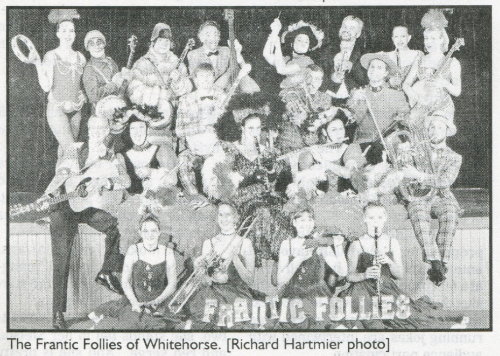
ago, just as the Frantic Follies Vaudeville Revue entertains tourists
today.
Stampeders would come to town from the dredges and mine shafts along the Klondike's creeks looking for some entertainment. They wanted to laugh at the comedians, be amazed by the magicians and even flirt with homesickness as the headliner belts out a tune from gentler times back home.
Today's tourists want to break out of their RVs and tour buses to sample some Yukon history and culture. They want to suspend their purported sophistication and laugh out loud at corny jokes, slap stick and most anything else that will amuse. They want to be amazed by the depth of talent of a troupe that plays 50 different instruments. And they want to flirt with homesickness as the headliner belts out tunes from gentler times.
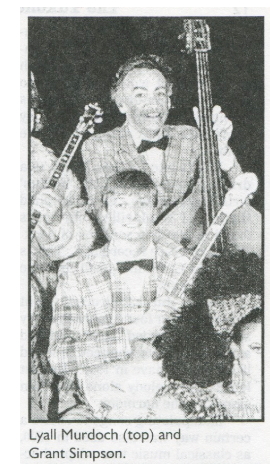 Lyall Murdoch and Grant Simpson do not call themselves historians and they don't intend to educate their audiences. But as co-owners of Whitehorse's Frantic Follies, they want to entertain their guests in the spirit of the Klondike Vaudeville Show.
They want to give their audiences a taste of Yukon history. But more than that, they want them to remember Whitehorse fondly as the place they laughed... a lot.
To accomplish this task, they had to adapt 1900 entertainment to something more fast paced. Lyall says he wouldn't attend a truly authentic vaudeville show since there were a lot of gaps. The master of ceremonies (usually the owner of the theatre and not necessarily suited for such a job) would introduce a singer, then a magician, then an animal act, then a comedian.
"A joke book from the turn of the century is not funny at all," says Lyall. The material depended upon comedic geniuses to pull it off. Grant adds that a lot of the jokes were racial slurs that would not be appreciated today even in the name of authenticity.
So they have cleaned up the humour, made it funny and still relative to the 19005. Grant offers an example: He wanted to add a contemporary joke about taking an entire package of Exlax to cure a cough... the patient would be afraid to cough (da-dum-dum). Exlax was changed to castor oil because they didn't have Exlax at the turn of the century.
Lyall's late brother, Jim, was a driving force behind the Follies' birth 31 years ago. He researched the era of Vaudeville from books found in obscure sections of book stores and rare recordings. This is a process Grant and Lyall continue to enjoy today.
As the musical director, Grant either wrote or found contemporary songs and "ragged them". He said any song could be changed to sound like it would have in 1900. He just leaves the melody alone and then simplifies the harmony.
Manipulating songs to sound a certain way was also used in 1900, as classical music was adapted according to the ragtime rules. Familiarity is the same motive Grant has for his audiences today.
The resulting atmosphere in the theatre welcomes the audience members with a ragtime piano playing in the background as they are shown to their seats by young ladies in period costumes. The Master of Ceremonies is introduced with a flourish and he immediately paints a picture of the Klondike at the turn of the century.
The audience has thus been prepped for Gold-Rush-flavoured entertainment. And it is delivered at a fast pace as characters from one sketch find themselves in the next with one quick scene change. And running jokes are intertwined with audience participation.
But what Whitehorse visitors are not prepped for is the quality of the entertainment. The buffoon from one sketch five minutes ago is now delivering a tune with a wicked intensity on the banjo and then serenading an audience member with a barbershop quartet.
From The Minstrel Show's groaners to the well-choreographed and surprisingly humorous presentation of The Cremation of Sam McGee, the audience is treated to a full package.
But between all of that, the audience can take a peek at characters inspired from the streets of Whitehorse and a scene from inside a snowbound cabin that is timeless.
Lyall and Grant want to blow the audience away every time to get that word of mouth advertising working its way up and down the highway.
And to encourage their 35,000 to 40,000 guests each season to pause to appreciate the Yukon a little more, they leave them with a verse from Robert Service's Spell of the Yukon because, really, he said it best.
* * * * * *
Jan Wotton does not call herself an historian she is an ..."hysterian".
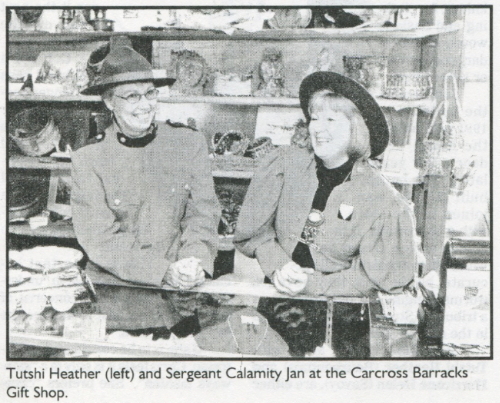
As the owner of the Carcross Barracks, she greets a thousand tourists a day in the persona of Sgt. Calamity Jan, of the Royal Carcross Mounted Police.
"I'm looking for scalawags, scoundrels and dance hall loungers," she will announce to the startled passengers of a tour bus.
Although she is only five-foot-two, she stands tall in her Stetson and red serge. And she is pretty sprightly for someone who claims to have come over the Chilkoot Pass in 1895 to establish authority over the lands.
Just as the Northwest Mounted Police were tasked a few years later to control the stampede of would—be millionaires on their way to the gold fields of the Klondike, Sgt. Calamity Jan continues this good work today by locking up "undesirables".
A few good-natured tourists are accused by their mischievous seatmates of various trumped-up misdemeanors and they are hauled off to the jail inside the store. Camcorders capture the scene and everyone enjoys a belly laugh before checking out the Yukon-made crafts for sale.
Jan says visitors will soak in the beauty of the Yukon, but they will remember their experience at the Carcross Barracks with fondness because the memory is delivered with humour. And when they look back on their visit, she hopes they also remember the lessons she has managed to slip in.
Such as the fact the Northwest Mounted Police played a vital role in the growing communities and did it under difficult living conditions.
Customers can inspect the construction of the building, a canvas tent with vertical logs making up the outside walls. Built in 1920 by Johnny Williams, there were no more large logs for a horizontal construction since boat-building Stampeders had used them up.
Today there is still no running water and the building is heated by a wood- burning stove.
Although the cabin really was used as a police barracks, its present use gives an additional glimpse of the northern lifestyle at the turn of the century. Just as trappers and native people visited a Hudson's Bay Post to trade goods, the Carcross Barracks is a hub for Yukon artisans.
And a favourite spot to conduct business remains the area around the wood stove.
Almost everything on the store's shelves was made by Yukoners and sold on consignment. There are even trade beads that could have been crafted a hundred years ago.
The inventory still offers clay sculptures, shaman masks, moose-hide moccasins, snowshoes, hand-made knives, fur clothing and baskets woven of red cedar, pine needles or silver birch.
Jan bought the building in 1991 and added the house next door a few years later. The house, built in 1898, was joined to the store with a boardwalk. It includes an ice cream bar, which isn't very historically accurate, but at least they have ice worms hanging out of the cones as a tribute to Stroller White's creation in the middle 1900s.
Sgt. Calamity Jan, along with Tutshi Heather (Bourbonnais) and Hurricane Helen (Savoy), are either the first Yukoners many tourists meet, or the last. Therefore, they feel a serious responsibility to ensure the experience is educational and wacky.
* * * * * *
A Caldwell poster makes peoples top and stare.
It's easy to spot her distinctive style. A few moments spent scanning one of her many scenes from the Yukon's past, the viewer is rewarded with a chuckle.
Caldwell fans know there are hidden jokes throughout her posters. If you don't see it the first time, you'll see it the next time or the time after.
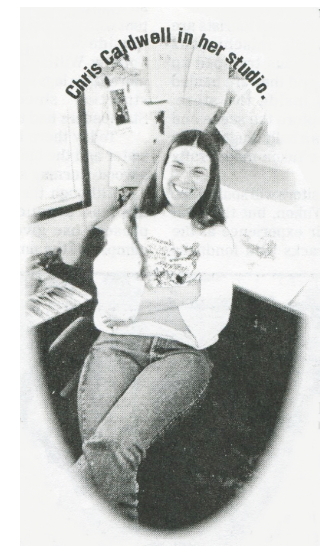 Chris Caldwell says the longer people look at her posters, the more they will learn the historical facts behind the scene. And the humour helps viewers put themselves into the scene.
This is important because Chris wants people to "understand" the issues and concerns of the day and not just memorize the facts and figures.
If she is to be considered an historian, Chris feels it is only in a "sideways fashion". She prefers "chronologist of our times". Which is a fancy way of saying she shows a snapshot of one scene that pulls together the elements of the time.
These elements have been discovered and recorded by "real, lettered historians" such as Jim Robb, Roy Minter and Ken Spotswood.
Chris will spend 11 months researching the subject of a painting. From the Internet to the archives, she will pull together dry facts and testimonials. Photographs from every possible angle will be blown up and studied. Old Sears catalogues will suggest the fashions worn by the subjects. And she will immerse herself in the sport or the job or the activity she is depicting to get even the smallest detail right.
Casual observers of Chris' art would be shocked to find that these whimsical cartoons are loaded with facts and authentic in spirit.
But she will throw in "romantic fiction" to make it more interesting for the viewer. Her "Hero in Red Serge" depicts a rugged Mountie overcoming an attacking bear with one hand, clutching a baby in the other while charging over a snowy mountain pass. It isn't factual, but the details are authentic and it is true to the romantic image of the Mounties.
Another poster, 1995's "The Discovery of Klondyke Gold - 1886", shows the exact moment gold was discovered in Rabbit Creek. Although there are conflicting accounts of this moment, Chris was able to include the key elements.
Although George Carmack registered the claim, it is widely believed that Skookum Jim found the first nuggets, so it is he who is shown at the water-s edge with a handful of nuggets.
It is also believed that Kate Carmack was away at a fishing camp with the local Han women. But attempts to rewrite history, saying she is the one who discovered the gold, are at least acknowledged by showing her in a hammock. Chris says she serves as a reminder that when a woman is in camp, she is in charge.
Besides helping the Yukon remember the 100th anniversary of the discovery of gold, she has helped the RCMP commemorate its 100 years in the Yukon with a series of posters.
And the image of the Yukon has been furthered by commissions from the Yukon Quest International Sled Dog Race, Yukon Sourdough Rendezvous and from many other events and organizations.
Her body of work presents Yukon history in a way Yukoners like to have it remembered.
* * * * * *
A webmaster, two entertainers, a storeowner and an artist.
It is important to note that all have a passion for their vocation and all rely heavily on bookish historians.
But, more importantly, they are proud of the Yukon and thrilled to share its rich history and beauty with the world.







