
|





|
|
The Palm Sunday Avalanche on the Chilkoot Trail, 1898:
Updates on April 9, 1898
The Palm Sunday Avalanche
Klondike Gold Rush
The Slide Cemetery at Dyea
Dateline: November 17, 2025.
The Dyea Trail (Dyea, Alaska) - Saturday, April 9, 1898
The horrible calamity that happened last Sunday at Stone House, where
fifty or more persons were buried alive under a tremendous avalanche of snow and ice, is now the absorbing topic not only in Dyea, but all over the world. The sad messenger of death is on its way to anxious mothers, wives, sisters, children and friends in all parts of the country. The uncertainty about the number actually buried and how many remain in their icy graves wrapped in their shroud of spotless white, adds to the horror of the awful catastrophe. Every family who has some member en-route to the gold fields, will grieve even more than those who have actual tidings of death. Realizing the anxiety which will be felt The Trail will endeavor to give as correct a list as possible of those who lost their lives.
Many erroneous and injurious reports have gone forth in regard to Skaguay. Statements and Flagrant untruths that should put to shame the authors; but Skaguans have no shame. Their ambition seems to be to heap misery upon others, they glory
in publishing false statements; they are ghoulish enough to wish that there had been 5000 buried if it only happened on the Chilkoot trail. What care they for the thousands of anxious relatives at home? They show no respect for the dead; but apparently take hellish delight in magnifyng the awful ficton, and in the hour of death to take advantage of this sad calamity by advertising their fever-stricken hole of hell.
In order to give our readers the facts, we will take us on the trip from
Dyea to the summit - try and print them a pen-picture of the scene of the snow slide, and of the trail the entire length, and thus enable them to gain a fairly good idea of the only natural passageway to the interior of Alaska. The writer left Dyea on foot at 7 A.M., on March 30th, went to the summit and was back in Dyea the same day.
The scene of the accident is about 18 miles from Dyea and two miles above Sheep Camp. It did not occur on the main trail, but in a draw - a kind of cut off - there was no object in using it; no necessity at all, and the people were warned of the danger
they were in, but the warning was unheeded. The Indian packers quit work and that locality two days before the occurrence. Sam Heron and Jack Cavanaugh, two of the most experienced and noted guides and pioneers of this country, have frequently warned people who were camping there of the danger of the slides which occur in the vicinity - but, somehow, their warnings were unheeded.
Mr. A. Mueler, of Vancouver, who was buried six feet in the avalanche, and was rescued alive, gives a most graphic description of the terrible affair. He was dug out after being imprisoned three hours. Mr. Mueler was conducting a restaurant at the Scales, and his story is as follows:
"I had one of the most substantial buildings at the Scales, and, although we were a little uneasy about the heavy fall of snow, myself and partner, Mr. Joppe, did not apprehend any danger for ourselves, but the constant small snowslides which occurred during the night gave us uneasiness about neighbors who were in tents. About four o'clock in fhe morning, one of our neighbors came rushing to our cabin and yelled, for God's sake
to come and help him; that a slide had buried the Maxsons in their tent. We hurried with shovels to the rescue and extricated Mrs. Maxson and two others. Fearing another occurence of the kind, we aroused the camp and concluded it was not safe to remain longer and concluded to pack up for Sheep Camp. While we were preparing to leave, the Chilkoot Tramway construction gang came down from the summit, and urged us to move at once, and we concluded to follow them. They gave us long rope to enable us to keep together and started
ahead of us. About fifteen minutes after we got in line, I concluded that we might need shovels to clear drifts with, and made everyone who could procure one do so. After procuring the shovels we took hold of the rope and started with Mr. Joppe in the lead. We proceeded down the trail about one thousand feet below the Scales, where we entered the
draw - a low ravine just above the O. & I. power house. As we entered it we heard a low rumbling sound. Someone shouted snow slide; but I thought it the howling of the wind and answered back to her to that effect. I had hardly gotten the words out of my mouth when I found myself buried to the hips in a solid mass of snow and ice. I did not have time to think before I was pushed over on my side by another mass and covered to a depth of six feet. I realized the awful fate in a moment. I knew it was not myself alone that was buried, but that perhaps those on the last end of the construction gang, who were ahead of us, would be ahead of the slide and possibly save us.
"I thought of home and friends - every act and hope of my life crowded into my mind in a moment - but I did not give up the hope of being saved, I could not move hand or foot, I was held as fast as if I were in a plaster-of-paris cast. I did not shout or cry out, as I realized I needed all my breath and strength. I could hear people near me groaning and praying; but in only a few minutes all was still, and I became unconscious. I fully realized my position - it was not at all tortuous, but simply that of going to sleep. When I awoke I found myself on the floor of the power house; and it was sometime before I could realize it all happened. I was considerably bruised and was black and blue all over; but I feel that no permanent injury will result. They tell me I was buried three hours. They took out seven alive that were on the rope with us; but four of the seven afterward died.
"A singular and romantic episode occurred after I was taken to the power house which is worthy of publication for the deserving little heroine.
"Miss Vernie Woodward, who has been on the trail over a year, packing freight on her back, and managing five pack-horses which she had bought with her earnings was one of the first to reach Sheep Camp. She came to the power house to aid the injured and tend to the dead, when she discovered in the row of dead the body of Mr. Joppe, who she had known for a long time, and was very much attached to. When she recognized him, her giref was unbounded. She cried and begged for him to come back to life to look at her. She unfastened his shirt, and in frenzied grief began to rub him. She worked upon him as only a true woman will - moving his arms this way and that; pressing his chest and breathing into his lungs until three o'clock in the morning. She was then rewarded by his opening his eyes ahd speaking her name, 'Vernie.' Everybody shed tears of rejoicing.
The little heroine and hero were at once taken to Sheep Camp. Mr. Joppe is out of danger and Miss Woodward is the heroine of the hour."
Forty-eight bodies have been taken out up to the present time. The names
will be found on the first page.
Mr. P. Young, who was on of the first to arrive on the spot and who extricated Mr. Mueler says that in fifteen minutes after the slide occurred there were 1,500 men on the spot working like heroes to extricate the sufferers. Some of them were buried 30 feet deep. He says that those people were instantly killed by concussion - the mass of wet snow that came down was almost beyond comprehension. It came down the steep mountain side 3000 feet and covered ten acres. It came with such force it solidified at once almost like ice. Mr. Young thinks there are many more still under the mass of snow but does not think they can be recovered till the summer thaw.
The Chillkoot Tramway people in every way possible, spared no expense in trying to rescue the victims and will keep a force of men at work until they are satisfied the last one is out.
Many of the bodies were taken to Dyea and sent to friends. Others were buried in the cemetery at Dyea.
The trail, which had been closed for the time, was opened again yesterday for traffic, and packing was resumed over the summit.
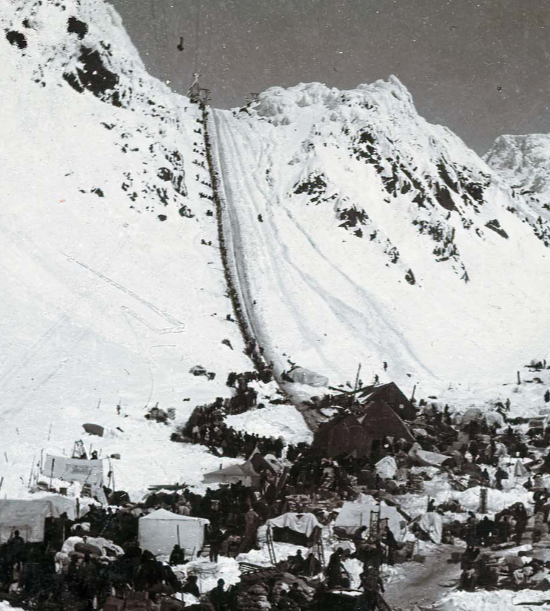
Chilkoot Pass
A brief description of the trail from Dyea harbor will perhaps be
appreciated at the time. Dyea, been west, most pretentious, and most northern city in the United States, is situated on a high, dry and sandy beach, in a beautiful valley, at the head of Lynn Canal, nestled and sheltered between towering eternal snow-capped mountains. The Weisman and other living glaciers tower high on either side. Two branches of the Dyea river flows to sea on either side of the city. The valley is about one mile wide and extends to Canyon City, a distance of nine miles. The summit can be seen from Dyea. It is
not as high by a thousand feet as the mountains on each side, and has the appearance of a saddle in a gap of the mountain. The city of Dyea has some very fine and substantial buildings, and there is scarcely a vacant lot for a distance of three miles. At that point we come to the famous Kinney bridge, over a thousand feet long - a toll bridge, which the prospector must cross in the summer time. This bridge crosses the west or main branch of
the Dyea river to an island of about 60 acres which is heavily timbered.
In fact, the entire bottom land on both sides of the river are well-timbered. From the island the trail runs along the edge and river bed clear to Canyon City. The river is low in winter months and frozen over.
It is very shallow in places and changes its channels frequently, making the bed of the river, which is full of boulders all the way, from a half to three-quarters of a mile wide. Most of the teaming is done in the winter and spring time on the bed of the river.
About five miles from Dyea we come to Finigan's Point, which makes out from the mountains to a deep and rapid place in the river.
This point has been located and a short toll road built across it to what
they call "head of navigation" - called so because Indians sometimes in the summer manipulate their canoes up this far. From this point leads up the old rocky river bed in a
go-as-you-please zig-zag way, to Canyon City, a very picturesque spot. Here we find at the foot of towering mountains a new and unpretentious city - there are comfortable hotels, restaurants, saloons and business houses. The mammoth power house of the Chilkoot Railroad and Tramway Co.
In going into the canyon you find only room for a single team. The road is only available in the winter when the river is frozen over. In the summer it rushes madly through the canyon in a tremendous volume, which makes it utterly impassable after the ice breaks up, which is generally about the first of May.
The Canyon is simply a scene of grandeur - only about forty feet wide, with perpendicular mountains rising thousands of feet, and almost closing together at the top. The Canyon is very crooked - winding, like a corkscrew - for a distance of four
miles. Going through the Canyon the first thing which one notices is that he is going uphill.
Emerging from the Canyon at the upper end you come to Pleasant Valley - a romantic spot covered with spruce and cotton-wood trees, making it an ideal camping spot. One mile further on and up at the foot of two towering mountains we come to the famous Sheep Camp, called so from the fact that years ago a party drove a flock of sheep through to Dawson, and camped on this spot for several weeks.
Sheep Camp is a rough, rugged, rocky spot with little space for a town
site, and today there is scarcely an inch of available ground. It is covered for over a mile square with tents so thickly set as prevent one passing between them in any instance. There is but one street and that a semblance of one - it being only about sixteen feet wide, and winds haphazard along the bank of the river. Numerous small stores do a thriving business here, as well as the many saloons. There are two drug stores, a hospital, fifteen
hotels and restaurants, coffee-stands and lodging houses too numerous to mention. There are also two laundries, a bath house and several store houses.
Outfits are hauled to this point on sleds and from here are packed on
slides, dogs, etc., to the Scales, four miles above. Here begins the hard work for man and beast. About a mile from Sheep Camp we come to what is called "Stone House." This is a great boulder or immense rock setting high by itself, and derving its name from the fact that it has an overhanging shelf which affords some shelter in heavy storms. Nearby is the beginning of what is called "long hill," and is something the shape of a whale back. It is the most tedious and tiresome strip of the whole journey - even more so than the summit. It is about half a mile wide and slopes off right and left toward the mountains, forming on each side a sort of ravine. Here many prospectors would pitch their tents and cache their goods, dragging them piecemeal on dog sled to this point, then go back to Sheep Camp for another load, and when they have gathered all their stuff together they stake a tackle and fall on the top of the hill, fasten their sleds to the rope and by merely taking hold of the up hill end, walk down and draw the sled loads up and continue this until it is all over.
It was in one of these ravines that the awful slide occurred. From the
top of Long Hill, which takes about an hour to walk up, they go down a short incline and then up another even steeper than Long Hill, but not so difficult to climb. Over this hill
and you are at the Scales.
The Scales is like a big basin in the top of a mountain. There is from ten to twenty feet of snow here most all the time. Shacks and tents are mostly eight and ten feet below the surface of the snow, and the same thing exists at Sheep Camp.
The town is composed of about forty tents and five or six buildings.
Messrs. Fuller and Joppe had a fine restaurant there and did a big business.
The Scales derived its name from the fact that in times gone by, the
packers had a pair of scales at this point to weigh the freight.
There are three tramways in operation from the Scales to the top of the
summit, and they do very effective work. They have a capacity of 20 tons per day, and the big Chilkoot Tram, which has its cables laid from Canyon City to Crater Lake, is now about ready for operation. Men can easily pack 150 pounds up and over the summit. Steps are made in the snow, and in good weather there is a continual string of people going up
these snow stairs - men and women and children. The packers go up this way, and in coming back slide down a sluice or a rut made in the snow - it is like going to the top of a big hill and coasting down again on the seat of your pantaloons. The distance is about a quarter of a mile.
The trip is very fascinating and not at all difficult. I would not miss
the grandeur of this trip for thousands of dollars. The top of the summit is completely covered with outfits - some of them buried 30 to 40 feet in the snow.
The Canadian Customs Officers are stationed here in their tents. They
are not any too comfortable, but manage to endure the exalted and stormy position. They have their wood for fuel packed to them from below Sheep Camp and pay five cents per
pound for it. From the summit down to Lake Linderman (nine miles) is a very easy trip, being all down a gradual grade.
Harry Holt, who was taken out dead, was one of the most popular young men in Tacoma. It is said that on the morning of the avalanche, he told his comrades that would be his last day at work for the Chilkoot Railroad and Transport Company; that
he intended to start for Tacoma at once, where he was to be married, and return with his bride and go into the interior. His wedding day never came. Instead, his dead body was sent to Tacoma. He came from one of the oldest, best known and most respected families in Tacoma.
Said Mr. Black, a man who was taken out alive and well:
"I was one of a large party which had started from the Scales. We were
lined up along a rope. It was snowing and the trail was almost obliterated by the freshly-fallen snow. I had no warning of the avalanche. It was upon us before we knew it. I found myself buried, and realized at once what had happened. My legs and one arm were outstretched. The outstretched arm lay across the body of a woman, whom I afterwards learned was Mrs. Maxson. My other arm was doubled on my chest. I could breathe only
with great difficulty. After a great deal of patient effort I worked my hand up from my chest and removed a little of the snow away from my mouth and nostrils, which gave me
great relief. Encouraged by this I completely exhausted myself in efforts to work my legs and other arm loose, but I failed to budge them. Tired out, I dropped off peacefully to
sleep. Several hours afterward I awoke greatly refreshed and distinctly heard the sound of the first rescuing shovel struck into the snow. A very distinct change had taken place
while I was sleeping - all was silent when I awoke. Not a voice was to be heard under the snow. Before I went to sleep the voices of the entombed reached me from all directions. Many seemed to be praying and some were muttering good-bye to relatives at home. Everyone was talking. It was the most ominous and impressive time of my life. I shall never forget it. I did not suffer any pain. My agony was mental."
It is said that when Mr. Black was uncovered, he laughed and told the
rescuers to pass him by in favor of others who needed more attention.

Prior to the appointment of the Citizens' Committee at Sheep Camp to take charge of the disentombed bodies and their effects, a number of bodies had been taken from the slide, and it is alleged on good authority that some of them were looted of money and valuables. But every suspicion of this kind ceased with the appointment of the Citizens' Committee, which was composed of the most prominent and respected men of Dyea and Sheep Camp. This Committee examined each body carefully, made a minute memoranda of all personal
effects and made the best disposition of the same that was possible under the circumstances. Death certificates were also issued, and a complete record of all transactions kept. The Committee did not handle the bodies of the Chilkoot Tramway Co.'s dead. That company looked zealously after the victims who had been in its employ. A list of the principal effects found on a number of the bodies, and a record of the Committee's work will be filed with the United States Commissioner's office at Dyea. The principal effects found on a number of the bodies is here given. As far as possible it includes the bodies handled by the Committee, but not those of the C. R. H. T. Co., which has kept a faithful record of all effects of its unfortunate employees.
More news: Saturday, April 16, 1898
|

|
