Special Correspondence of Post-Intelligencer.
White Horse, Y. T., Nov. 22. - Rev. I. O. Stringer, late rector of Christ church, White Horse, has been elected by the house of bishops at Winnipeg to succeed the Right Rev. W. C. Bompas as bishop of the diocese of Selkirk, commonly known as the Yukon territory.
William Carpenter Bompas, D. D., has well been called the apostle of the North, and has spent over forty years of his life among the Indians and Eskimos of this
far Northwest.
Born in London, England, over seventy-five years ago, he was an articled clerk in a legal firm until his departure to Canada as a missionary of the Church of England Missionary Society. Leaving London in 1865, he came straight to Fort Garry, now Winnipeg, just in time to pass on by the Hudson bay boats up the Saskatchewan, across to the Athabasca river and lake. Pushing on in a canoe with two men, they were at last caught
in the tce and had to make their journey on foot to Port Simpson, which place they reached on Christmas morning.
Made Bishop in 1873
Years of faithful work followed. In 1873, he was summoned "home" and consecrated bishop of the new diocese of Athabasca. On his return, he was not alone, for
he was accompanied by his bride, a lady who has proved a most devoted and valuable helper.
In 1844 the huge diocese was divided, the northern part, known as the "Mackenzie river," being retained by the bishop. In 1887 a further division was made, and the western part became the diocese of Selkirk, with W. C. Bompas as its first bishop. Here he was found patiently working among the Indians when the discovery of gold opened up the whole land to public view.
A volume only could do justice to this remarkable man, who crossed the Rocky mountains twelve times on foot, spent years in foul Indian wigwams, endured dangers of the most thrilling nature, and, when opportunities affored for much gain, refused to stretch out his hand for even a few nuggets to supply the comforts of life. He has retired with honor, and is spending the rest of his life at Caribou Crossing, working among the Indians and translating the Syriac version of the Bible into literal English. His two published books are a "History of the Diocese of Mackenzie River" and "Northern Lights
on the Bible."
His Successor Is Young Man
His successor, the Rev. I. O. Stringer, B. A., a young man of 38 years, is well fitted to follow in his footsteps. After graduating at Wycliffe college, Toronto,
in 1894. he left for Herschel island, in the polar sea, 200 miles west from the mouth of the Mackenzie river. There he found the Eskimos, and, studying their language, taught them the truths of Christianity. A blacksmith shop put up by the whalers was used as a church. In 1897 Mrs. Stringer accompanied her husband as a bride, and lived four years on this island, which Bishop Reeve calls "the most northerly inhabited spot in the British dominion, and perhaps the most inaccessible" - a bleak, desolate, treeless island, ice bound for nine months in the year. Here his first son, Herschel, was born, and named after the island.
Mr. Stringer's eyes failing, he was forced to abandon his work in the Arctic and became rector of Christ church, White Horse, where for two years he has labored faithfully.
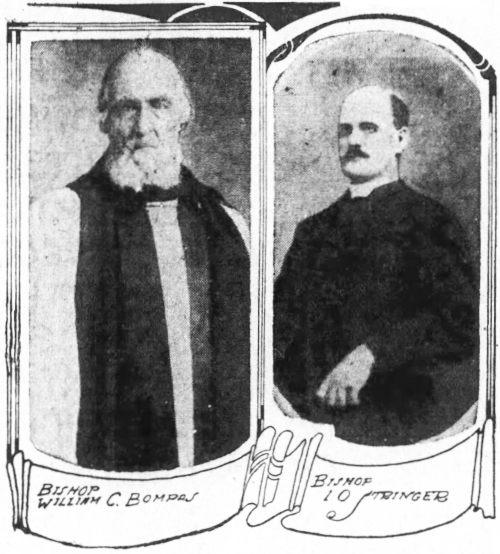
Bishop William C. Bompas, and His Successor, Bishop I. O. Stringer