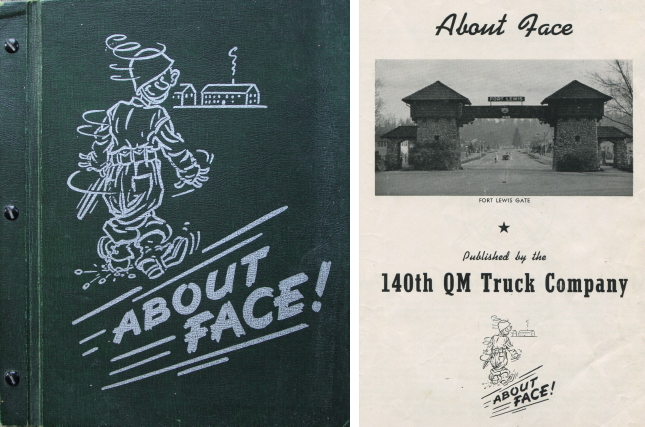
The National Guard Armory in Walla Walla, Washington, was the scene where a special ceremony was in session, late one evening on the eventful day of April 1, 1937. The purpose of this ceremony was the birth of a new Quartermaster Company, known as Company B of the 116th QM Regiment. The personnel of this company consisted primarily of men who had transferred from Company F of the 16lst Infantry Regiment; a local company, and other recently recruited men. Captain Jacob P. Jakey was appointed the company commander of this newly formed organization and Lt. Wayne W. Saltmarsh was one of the
junior officers.
Every year during the summer months, all the National Guard units in the 41st Division, assembled in the Camp Murray area for a two-week period of bivouacs and maneuvers. Only four of the original members of the company who attended its first "camp" are at present within the ranks of the 140th being Argo, Jilg, Ramey and H. A. Williams.
When the President issued the order for the mobilization of the National Guard for one year of intensive training in the fall of '40, a temporary camp area was constructed at Camp Murray, consisting of row after row of pyramidal tents. In spite of the rain, sleet, flu epidemics, etc., the newly adopted training program was underway.
Many humorous incidents took place during those first few months of training which helped maintain the high morale, contested by the trying weather conditions. However it wasn't all laughter; for instance, there were those nightly four-hour hikes with full field equipment, Regimental parades and driving those "rough ridin'" Dodge trucks. Such were the days filled with laughter and tears as the men in Company B struggled through the basic training program.
A group of the Selective Service men who had been undergoing a six weeks' period of intensive training in the 41st Cantonment, in order to bring each company up to strength, joined their designated companies of the 116th Quartermaster Regt. on March 15, 1941. Practically all the new men had experience in driving trucks previous to their induction and this proved an asset to themselves as well as the company, as time need not be taken for teaching fundamentals but all were capable of assimilating the advanced training in convoy practice, troop movements and individual operations.

There had been a lot of hope and wishful thinking about the summer maneuvers for the year of 1941 and each man was hoping that the Army would land the company in his own particular vicinity so he could get away for even a day or maybe two to see the folks at home after being away several months. The preliminary maneuvers kept us fairly close to the 41st cantonment but when word came that the arrangements were being made to go down into California for the big tryouts, there were a lot of happy faces
around camp on the boys from that state. The fellows from the south and eastern states were going to add two more states to the already long list through which they had traveled.
We left Fort Lewis about the 19th of May and after a week of convoy, arrived in the little valley known as Jolon. This particular area was purchased from
William Randolph Hearst, the newspaper king, and was originally a game reserve where he had set wild animals of all kinds out to roam the uninhabited foothills. As any of us who were there can testify, there seemed to be quite a colony of rattlesnakes, scorpions and other like pests, prospering in the area.
By the first of July all the spare fat we may have had on our bones had been boiled off and we were quite content to accept those most welcome furloughs and then rest up for a while until the next maneuver should catch up with us.

This is the "Red Letter" day that threw our hopes of Peace out the window and threw us into a war for the first time in our meager lives. At the time of the attack on Pearl Harbor by the Japanese, the company was scattered from California to Vancouver, British Columbia. The men that were over the twenty-eight year marker were to be released in a day or so and the convoy of drivers that had gone to San Francisco with trucks for the Philippine Islands were enroute home by train when the news of the attack was released
over the radio.
The men of the company that were in the camp area were assembled with orders by Captain Goodman to "prepare to move out." The following night the company transported the Infantry units to strategic points along the Pacific coast from the tip of Cape Flattery on the north to Fort Stevens, Oregon, on the south, where it is located at the mouth of the Columbia River. Men and trucks were left with each Infantry outfit and
a state of rush and confusion existed for the first week until the Infantry was entrenched in positions and the QM could settle down to routine jobs of hauling supplies and munitions to set positions.
By this time the company personnel were united in the rush and our camp was located in the brush skirting the 41st Cantonment where we "existed" in the heavy down-pour of rain that finally completely drenched us and we returned to the barracks where under strict black-out rules we operated until the latter part of January.
By the beginning of February the danger of immediate invasion or large scale bombing of the northwest Pacific was past and we settled down to an excited but smooth running machine and after the 41st Division was streamlined and moved out of the area, we watched units of all sizes and types move in and out of the cantonment. New units
were started such as the mountain troops and new jobs were created because of the rush of men that were always going through. The Service Club dances were always mobbed and after the 41st moved out of the area for oversea duty it seemed that the place was over run by the "boys from Jersey."

On the 18th of February, 1942, the 116th Quartermaster Regiment was among the plans made in the offices of the War Department and the plans for this Regiment, as was the same with other Regiments in the 41st Division, was to streamline the old square Division into the new and sleek triangular war machine. A conference was called for the officers in the 116th QM Regt. and each company commander was given his choice of breaking away or remaining with the Regiment.
Our commanding officer, Capt. Goodman, chose to break away and be redesignated as a separate truck company and his request was granted. We were endowed with a number and title of the 140th QM Company (trk) and as such we stand today (at time of going to press). "A" Company remained with the Regiment and when last heard of was seeing overseas duty. "C" Company was given the title of 186th QM Company (dmp) and "D" Company was redesignated as the 198th Engineers.
With the reduction of authorized men that were allowed in the Headquarters, Service and "E" and "F" Companies, the overage was placed with the 140th QM until such time as disposal could be made of them. Most of these men were transferred to positions where they were needed to better advantages but we made room for several in our immediate company which we have not regretted.

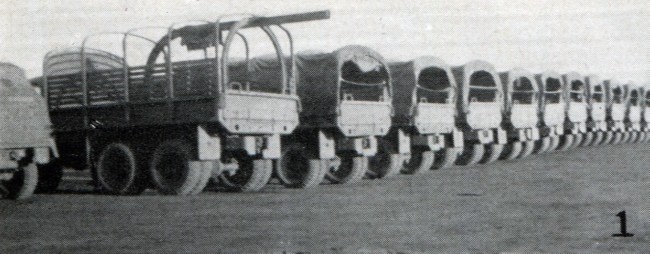
So many rumors had been circulating through our camp area as to when and where the company was to move, that practically every man was skeptical even when one of the rumors materialized and the rumor was no longer a rumor but a reality. We were to travel by train, the order from Regimental read, so all our vehicles which consisted of forty-eight 2½-ton GMC 6x6 trucks and three ½-ton pickups were given the
final check and made ready for loading onto the flat cars which were placed on the siding a few days later. After careful inspections by the Army officials of the loaded vehicles, three pullmans and two baggage cars were joined on and our train made ready for the long journey which lay ahead.
As the exact date of departure was not known to us, we were held in suspense until early on the morning of April 28, when we were aroused and a last minute check was made, then marched to the train and loaded on. This brought a sigh of satisfaction from us all, at least we could relax; behind us lay the rumors and daily routine; ahead lay new adventure.
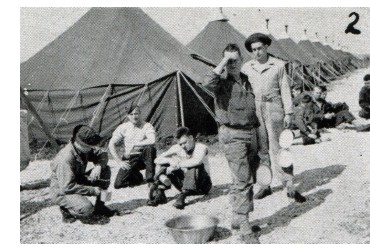
The caboose on the end of the train served dual purpose, as it was also a guard house in which the men on duty rode to check the vehicles for security at every stop of the train enroute to our destination. Our cooks, who had experienced practically all kinds of conditions in preparing meals from the backs of rolling trucks on deep rutted roads, to the hot sands of Jolon, set up their kitchen in one of the baggage cars and endeavored to prepare our daily "chow" amid the jolt, rumble, and swing and sway of the train.
Scenic country of all types, from the snow-capped peaks of the Canadian Rockies to vast expanse of plains beyond greeted our eyes. At numerous stations at which the train stopped for water, etc., the village belles turned out 100 per cent to glimpse, trade names, and cast shy school girl smiles at the Yanks from the states. Old Dan Cupid was constantly near and with his bow and arrow was responsible for many a romance which flourished strongly in the days to come.
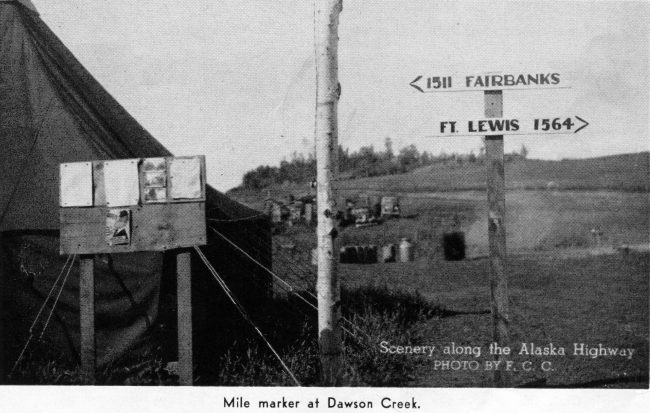
Four days and three nights we adapted ourselves to the monotonous routine of this mode of transportation and late on the evening of May 1, the train pulled into Dawson Creek, B. C. This was known as the "End of Steel." We disembarked and marched a mile to our new camp site, which consisted of eight tents hastily thrown up on a
field of fresh cut stubble. No sooner had we gotten our bearings than it started to rain and brought a climax to a trip which we shall long remember.

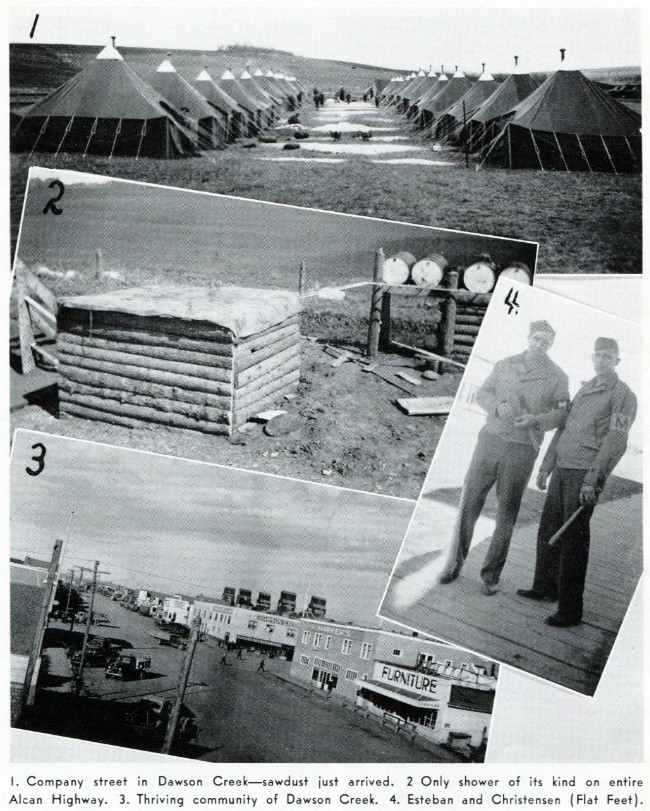
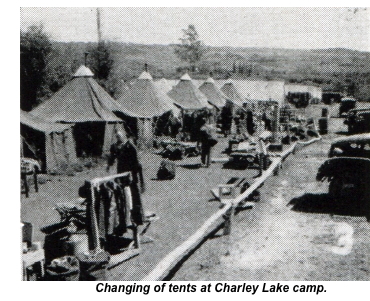
Arriving in Dawson Creek on the first day of May in 1943, our first major undertaking was the construction of a permanent camp site and permanent buildings. The tent area that had been hastily pitched before our arrival was inadequate for the housing of the whole company, so additional tentage was procured and the whole tent area had to be religned and kitchen and officers' tents pitched. The company street was covered with a heavy layer of sawdust and took on an appearance of neatness and order. The tents were our home during the first couple of months while we were building the mess hall, barracks,
garage and that little lone ediface with the moon studded door.
 The summer was in full sway with long hot days in which the sun set after 10:30 at night and it seemed like it never did actually get dark and heaven help the man that had to work from sunup to sundown at this time of year!
After a long day's work of carpentry in the boiling sun it was more a necessity, but still a pleasure to pile a dozen or two steaming carcasses into a pickup or truck and race off to Pouce and the old swimming hole. Six months later we were still
greatly concerned over that swimming hole because the Engineers were drawing the water out
of it for our drinking supply. (Of course, the frogs had been strained out of it and it had been chlorinated, but the old swimming hole had lost its old appeal).
Within two weeks after our arrival, the plans for a shower had been drawn up and the construction was underway with Fred Mumma bossing the job. This was the second shower to be built in the fast growing town of Dawson Creek and the first of its kind to be built on the Alcan highway south of Whitehorse in Yukon Territory. The town boasted one bathtub which would have probably brought its owner a tidy million dollars in business except for the risk that a person had to run in chancing the fears of being sucked under in the heavy accumulation of quick sand that had built up from the previous years. (This of course is strictly hearsay).
In August we had completed one barracks for sleeping quarters and the second platoon moved in under the leadership of Tommy Huff. Shortly after this the third platoon moved into their newly completed barracks under the leadership of Jimmy Field. The first platoon under Pic Williams seemed to prefer the tents and soon had them winterized and quite liveable.
The echelon shop was complete and the mechanics under "Red" Lovell were turning out a mighty fine job. The new trucks that soon rolled into the railhead arrived in such large numbers and requiring servicing: two grease racks were built to accommodate
them.
This was the arrival of the Studebaker trucks which later were proven the most practical truck on the Highway. The shop was forced to operate on a 24-hour schedule and as records will show, the majority of all vehicles in operation on the Alcan were serviced by the 140th. Also a large number of 4-ton Diamond T, six-ton F.W.D. and twelve-ton Diesels arrived at various intervals. This was considered an asset to us all as it was possible to widen one's knowledge of not only of operations of the various types of trucks but also learning the practical knowledge essential to all good truck drivers, as it is a proven fact that "only the driver who knows his vehicle is a good driver."

Due to the high transportation cost of shipping freight south, farmers in the locality surrounding Dawson Creek were more than willing to sell their produce for an unbelievable low cost. As eggs could be purchased for ten cents a dozen and an etra large T-bone steak for the small sum of thirty-five cents, coffee pots and frying pans were hurriedly purchased and each tent was transformed into a short order house.
From the first streaks of dawn until the dark hours of night the hissing of the percolator and the sizzle of the frying pan reigned high throughout the area, filling the air with an aroma that any famous chef would envy.
This did not, however, meet entirely wih the mess Sergeants' approval,
as the amount of men to mess daily would vary from day to day, causing much difficulty in the planning of the meals. After two weeks of this routine, the mess Sergeants were nearly frantic and on the verge of a nervous break-down, so the Skipper decided that all cooking utensils would be banned from use by the personnel under his command, other than those of the kitchen staff. Sorrowfully the men discontinued their culinary art and laid the coffee pots and frying pans aside but cherished their fond memories.

With the continual influx of men and supplies into Dawson Creek, by rail and thence north by truck, it became necessary to establish a secondary ration breakdown point which located itself at Charlie Lake, a few miles north of Fort St. John. QM Force 9469, a bakery and ration breakdown unit, was established under the supervision and command of Lt. Maizitis.
 The 140th at this time was composed of two platoons and when the urgent request for transportation was received, the Second platoon was placed on detached service with the breakdown unit at Charlie Lake. It was shortly after this that the new T/O came into effect and the company widened itself into three platoons and the old second Platoon became the third.
A highly efficient system of transportation was then installed, whereby the first and second platoons would carry the bulk of the material north to Fort St. John and Charlie Lake and the material that went to the breakdown point at the lake was then delivered by the third platoon.
Muskeg at its worst was encountered by the drivers of the third platoon as they drove their trucks almost directly behind the huge RD-8 Caterpillars which cut the swath through the timber for the road. As the road was opened up and the Engineer companies moved farther north, the ration unit moved to mile 81 and after a short time
moved to mile 121, a short distance from the Sikinnie River.
As soon as the camp at the new location was in order, two ardent fishermen, Larry James and Lou Rogers, equipped with flies, bait, plugs, rods and all the paraphernalia essential to the modern fisherman, set forth to try their luck in the rippling waters of the Sikinnie. Four or five hours elapsed, then slowly through the gloom
emerged two thoroughly drenched boys. When questioned as to what had happened, the only
response was a chatter of teeth, a string of profanity and a thorough condemnation of everything from the southern line of Canada to the snowy slopes of the North Pole.

The Dawson Creek Post Office and a warehouse owned by W. O. Harper, storekeeper, were destroyed by fire which broke out at 5:30 a.m. on November 25, 1942. See a separate page about that event.
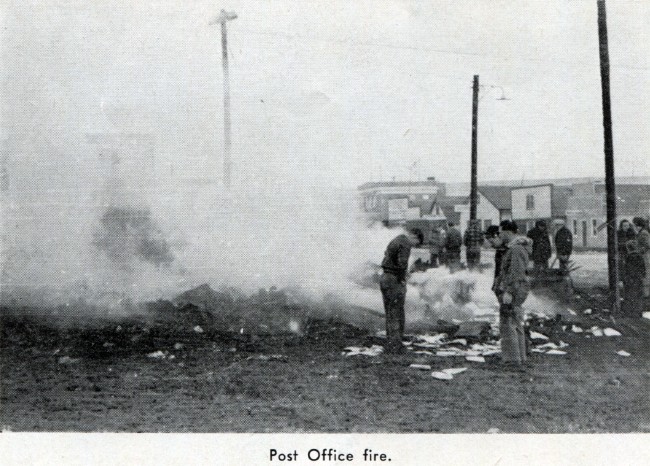

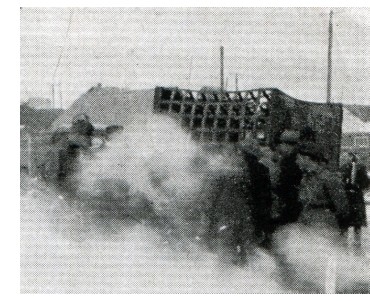 After the fire of the latter part of November in which the Post office and several other buildings were lowered to the ground, a lot of measures were taken to prevent its reoccurrence. Fire signals and fire fighting apparatus were installed and inspected. These precautions were put to almost immediate use by the early morning fire
of December 13, 1942, in which the local Police Station and Jail burned and entailed the death of one prisoner, who was fatally burned
before a rescue could be effected.
After the fire of the latter part of November in which the Post office and several other buildings were lowered to the ground, a lot of measures were taken to prevent its reoccurrence. Fire signals and fire fighting apparatus were installed and inspected. These precautions were put to almost immediate use by the early morning fire
of December 13, 1942, in which the local Police Station and Jail burned and entailed the death of one prisoner, who was fatally burned
before a rescue could be effected.
It was the guard, Les Patterson, who fired the three shots of warning from his rifle to arouse the camp on that morning and again the company rolled out of their cots and raced into town to offer what assistance they could to the cause. The fire had spread so fast, because of the oiled floors in the building, that it was impossible
to do anything about the fire itself and the men stayed on only to be certain that the flames did not spread to any of the surrounding buildings.
The fire was so hot and fast burning that the spectators could not stand on the sidewalk across the street but had to move back into the empty lots. The company had been prepared for the fire by having trucks and ihe two four-ton wreckers at the scene of the fire.
It was always an oddity to us how the civilians could gather around a fire such as this and others that had occurred in town and not lift a finger to help extinguish the blaze, but they evidently came only to enjoy a few minutes or hours of free heat at some other unfortunate person's expense.
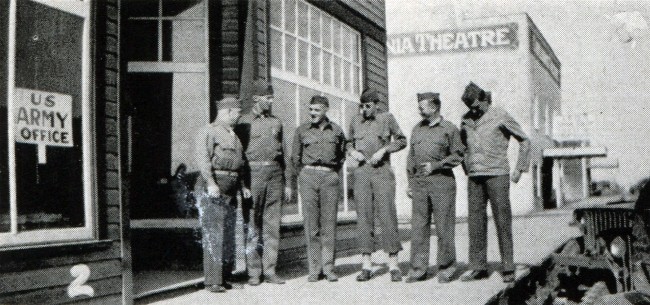
Railhead and Quartermaster Truck Co. officers.

A few miles north of the city, a new area was rapidly nearing completion, an area which would be the permanent base for all troops stationed at Dawson Creek. The task which confronted the various companies was the construction of their respective quarters. As practically every man from our company was either driving or on special duty, it was a difficult proposition to find time with which to construct our Neison huts at the new area.
Soon, due to a rainy period and a lull in the trucking of supplies, the Walter L. "Jake" Brown Construction Company was formed and proceeded to build our future residence. In three days' time, one hut was completed and three more partially built, when the emergency call came through for all available drivers, as the bridge across the Peace River threatened to go out from the rapid rising of the melting snow.
This was the automatic dissolving of this construction firm, so the matter was turned over for completion by the 341st Engineers. All the ground work had been accomplished, material hauled and a model hut to pattern after, so their job was comparatively easy. Within a few weeks the huts were ready for occupation, so the company moved in and endeavored to acquaint themselves with their new homes. After the walls of the huts had been transformed into an impromptu art gallery, consisting of species of the fair sex in artistic poses of dress and undress, a cozy, home-like atmosphere prevailed.
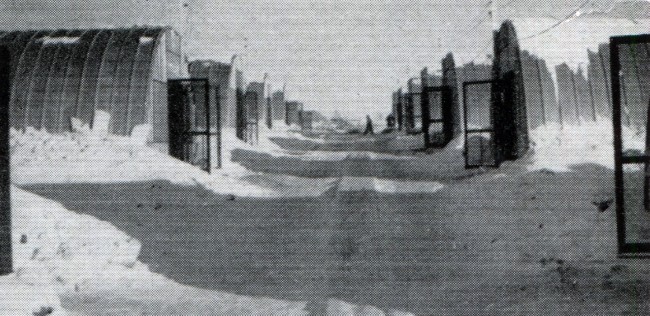
Company street in November 1943 - temperature 43 below.
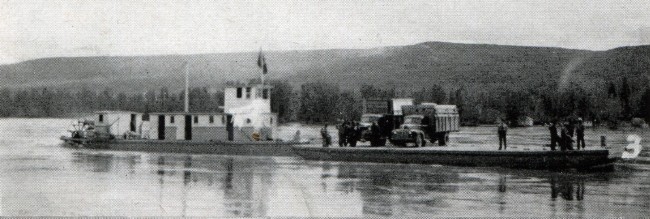
Peace River ferry.

Driving a 10-ton Diesel truck with a eight-ton cargo over an ice covered road when the thermometer is registering 40 degrees below zero, is hardly a situation in which any of us would care to experience, but such was the case in January of '43, when Harry Allen and Sam Patton were transporting a R. D.-4 caterpillar with cargo loader attachment to White Horse in a 10-ton Diesel to fulfill the emergency request for the
machine in that locality.
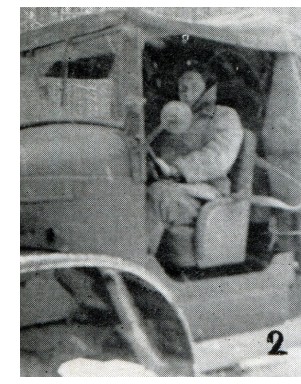 Driving under these conditions, with this type of vehicle proved to be a very ticklish proposition as not only was the road considered impassable due to the heavy snow, but relay stations were few in number and practically no traffic or other means of communication in ease of accident or breakdown.
In spite of these odds, Harry and Pat had volunteered for the job and if it were at all possible to complete the journey, they could do so. Sitting inside the
cab of a Diesel was practically identical to that of the interior of a refrigerator as every piece of steel was covered with a coating of frost. A heater was constantly in operation but due to the extreme cold was hardly noticeable. One of the peculiarities of the trip which will emphasize the existing condition was that the windshield remained perfectly clear. As a rule when the windows in the doors are up, the breath will cause the windshield to fog up and freeze but in this case, the breath froze before it came in contact with the glass.
Partially what kept Sam and Harry in such good spirits was that in the back of their minds, they knew that inside the jokey box was a nice 26-oz. crock of hootch. Early in the evening of the third day which had been very hectic and nerve-racking, Harry reached inside the jockey box and pulled forth the crock. Believe it or not, but the whiskey was frozen solid. Checking the thermometer inside the cab the mercury was level with 67 degrees below zero.
Postponing the craving for a nice warm shot of rye, they waited until the relay station at Destruction Bay was reached, then Patton, gripping the bottle numbly in his fingers, proceeded to thaw the contents by using hot water secured from the kitchen and if ever a man needed a drink, ole Sam could have answered the call. Whiskey by far was the most valuable and rarest of items in existence along the road, so when word circulated around that a crock of rye was in camp, the men flocked to the barracks and cornered Sam and Harry to promote a deal to buy the whiskey, turning down all offers, even when the
price reached the high peak of $47.00 for a bottle that had originally cost $4.50. The two boys when finished with the task of thawing the whiskey, lay back on their bunks and smacked their lips over a few drinks of this precious liquid, costing nearly $2.00 an oz.
Also it was at Destruction Bay that Sam and Harry experienced the most peculiar of uncomfortable circumstances anyone is likely to encounter. The mercury at this particular station was dropping continually and at three o'clock in the morning registered 74 degrees below, which is pretty nippy in any language. Along about this hour in the wee small hours of morning, came a warning that neither Sam or Harry could ignore, nor yet delay. almost simultaneous in their movements, they jumped out of their sleeping bags and raced for that lone ediface on yonder knoll. Thusly both these men can fully appreciate the full meaning of "Memories of a frosty seat in the early morn."
Reaching White Horse, they had accomplished their mission in very short order by delivering the much needed caterpillar exactly 43 driving hours from the time they left Dawson Creek, which is indeed a job done exceptionally well, considering the driving conditions.

Thousands of miles had been driven all summer long, an average of 600 miles per man per week by the men in the 140th, transporting supplies and troops from Dawson Creek to various stations along the highway northward as the road progressed. Regardless of the weather, night and the trucks rolled on schedule as the Engineer companies, cutting the right-way for the road were solely dependent on the supplies enroute from the Railhead at Dawson Creek.
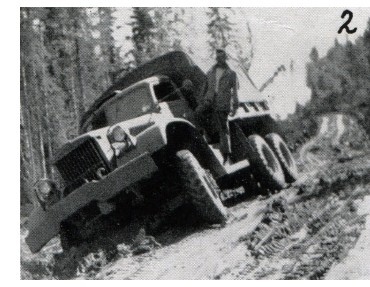 Caterpillars, graders, bulldozers, shovels and dump trucks were continually working the road, so it was a difficult matter on the driver's part to drive his truck loaded no less than two-ton and often as high as eight-ton over the narrow, winding road.
In mid-summer a number of civilian construction companies moved to Dawson Creek and a great number of camps were built to house the men employed. This added a larger amount of trucks and equipment to operating on the road, making it almost twice as confusing to drive as before. In all the long months of trucking, not one single load failed to reach its destination from a fault of one of the drivers of the 140th. (This has been taken from records).
As various other units smashed and wrecked trucks and other equipment through carelessness, negligence and sometimes accident, the 140th had only two serious accidents. One was the truck driven by Jim Sellers and Sam Weber on a return trip to Dawson Creek, due to a soft shoulder, which caused the truck to slide sideways then topple over a steep embankment and rolled to the bottom of a canyon below.
There were no critical injuries received, although Sam Weber suffered a few months of internal injuries received when both boys jumped from the truck as it left the road. Sellers was also very lucky, as he only received a bad jolting and a slight bruise on his side.
The other accident was a truck driven by Carrol Cambell; while driving at night, the truck lurched sideways when crossing an ice-covered bridge, swerved into the railing then plunged downward to the bottom of a thirty-foot ravine. Carrol also jumped as soon as he realized the truck was beyond control, but the force of his fall was the result of a compound fracture of one leg and a long, tiresome period in the Army hospital at Fort St. John, and later was evacuated to the station hospital at Fort Snell, Minnesota.

The spring thaw was well under way and the highway was considered impassable from numerous sources at Dawson Creek, so when word traveled around and up the road, officers and enlisted men alike, laughed and considered it quite a joke that the 140th was going to undertake a convoy to White Horse and then on to Big Delta, Alaska.
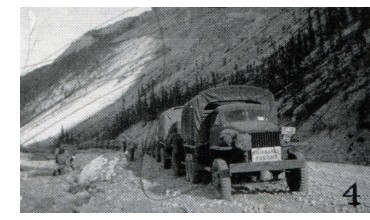
After a number of days of packing and making preparatory plans, the final orders were received and on the early evening of April 8, at 8 p. m., Capt. Busker gave the order to move out. The convoy consisted of twenty-four vehicles: six 6x6 2½-ton reefers, twelve 6x4 2½-ton trucks, one 2½-ton 6x6 tool truck and one Kenworth wrecker.
The trucks were far from being in top shape as they had been assigned to the company only a few hours previous to departure, so this increased the odds stacked against us to complete the journey which lay ahead.
 Lt. Aster, Gruenhagen and Bell drove a command car three hours ahead of the convoy in order to make lay-over preparations.
The road while being fairly slippery at the start was easily passable and the convoy rolled into the first and second stops two and one-half hours ahead of schedule. The average planned distance per day was 100 miles except in two instances, which were 200 and 180 miles due to hard surfaced roads.
Mud bumper deep, rocky ledges, washouts, ete., were a daily occurrence.
The fifth day brought the peak of the grueling test on both the men and the machines they drove. Fifty miles of soft, seemingly bottomless muskeg lay ahead, slowly inch by inch for ten long hours the trucks crept ahead. The 6x 6 trucks equipped with the front wheel drive, were capable of overcoming practically every kind of terrain, while the 6x6 trucks due to the low front axle, would high center time and again, but the grit, guts and determination to get through, possessed by the men, never faultered.
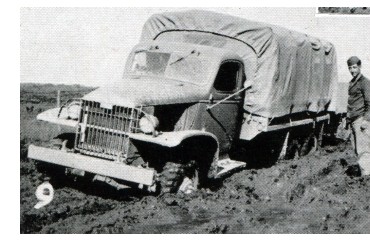 Wading knee deep in the mud, drenched to the skin, each man carried logs,
chopped trees, shoveled mud, etc., until every truck continued to proceed ahead. The morale of the men mounted as driving conditions dropped. Every new rumor that reached us concerning the terrific quagmire state of the road ahead, every morning, found the men raring to go in spite of "hell and high-water" the convoy would get through.
Wading knee deep in the mud, drenched to the skin, each man carried logs,
chopped trees, shoveled mud, etc., until every truck continued to proceed ahead. The morale of the men mounted as driving conditions dropped. Every new rumor that reached us concerning the terrific quagmire state of the road ahead, every morning, found the men raring to go in spite of "hell and high-water" the convoy would get through.
At every camp in which we rested over night, the din and rattle of the "galloping dominoes" echoed through the calm of the evening air. All the men stationed at these camps hastily endeavored to match their skill with that of the demon shooting, dice manipulators, of the 140th, but they tried in vain and the whole trip proved a very profitable one for the foremost artists of the game. According to the old proverb that "Experience is the best teacher," many a man will long remember the lesson he paid dearly for from "Whizzer" James, "Barrel Roll" Neumann and "Roll 'em Right" Mock.
The reefers were practically the only trucks which really showed the
terrific test, as each mile the frames would bend a little bit more in the center. One of these reefers, which really looked sick, was the "Low Belly Express," piloted by Cpl. Peerson. This was the reason for Percy "Button" Perrson's dubious outlook at each station caused by the peculiar change in appearance of his trusty speed wagon; the body was resting heavily on the back of the cab and thus as the body frame would gradually bend,
the area within the eab was decreasing rapidly, causing not only the doors to be off kilter but forcing "Button" to drive in a somewhat circular position.
Old lady Luck was constantly near and no mishap took place. On the early afternoon of the eighth day all twenty-four trucks rolled into Whitehorse, not one single truck had been wrecked or had to be towed, a job which they said was impossible was completed.
Among the men whose ability was outstanding, were those of the mechanics' staff, Alberti, Castellanelli, Lovell, Christtensen, Schwindt, Bower, Kain, and Allen, who were excellent and without their close cooperation and long, tedious hours of labor the convey would not have arrived at its destination.
The only explanation of how the 140th was capable of completing a 24 track convoy for 900 miles, through snow, ice, mud and muskeg in the middle of the spring thaw, was merely that all concerned had just "UNDERESTIMATED THE ABILITY OF THE 140th."
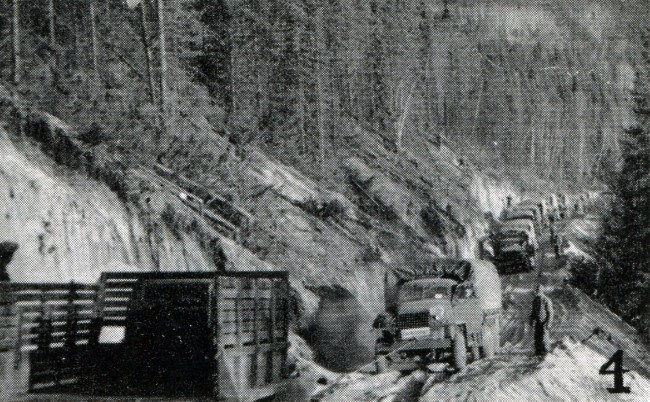

It was expected that the company would be camped temporarily in White Horse and after a few days' rest, continue with the original orders to proceed on to "Big Delta," a hundred miles south of Fairbanks. Little did we realize what the future held for us, for it was not long after our arrival that orders were sent down from the North West Service Command Headquarters that a number of bridges had been washed out and thus the 140th was to remain in Whitehorse indefinitely, or rather until the road was declared open.
The presence of the 140th in this area proved to be rather complicated, as no duties existed for a company of this size and type, as it was beyond anyone's expectations, here, that the trip would have been completed this far.
Waiting for definite orders, the company proceeded to perfect its camp site to the point where it topped any company or regimental area in this sector even to the point of a tall flag pole and an artistic fireplace constructed by Chester Dale and the Deacon.
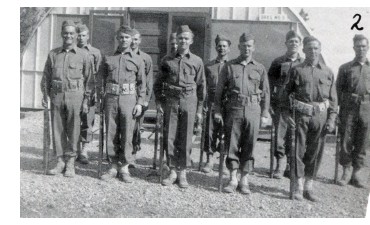 After the elapse of two weeks, the awaited orders, as to our duties as a company materialized, and what should be the outcome but to take over the Casual company and Guard duties of the Sector. This brought a snicker and a laugh from us all, the crack truck company with the finest record of any on the Alcan highway doing guard duty in place
of driving trucks - (could it be caused by jealousy on the part of the Engineers or the 477th QM? - we wonder).
After the elapse of two weeks, the awaited orders, as to our duties as a company materialized, and what should be the outcome but to take over the Casual company and Guard duties of the Sector. This brought a snicker and a laugh from us all, the crack truck company with the finest record of any on the Alcan highway doing guard duty in place
of driving trucks - (could it be caused by jealousy on the part of the Engineers or the 477th QM? - we wonder).
The Casual and also the Guard records were both in a total mess and the area was an eye-sore. Various rumors were circulated through our company by those none-too-bright, would-be associates, camped near by, one of which was "The 140th will sure make a flop of this." To counteract these rumors right at the start, a real live pep talk by our skipper, Captain Busker, and also by our Top kick, 1st Set. Argo, set all of us on an even keel, and once more as we had done numerous times in the past, "Hit the ball" and before long everything was progressing smoothly.
The credit of straightening all of the prisoner' records was due largely to the work of Sgt. Katberg, who had been appointed Provost Sgt. Sgt. Katberg was highly qualified to handle this position, as prior to his induction into the Army, he was a guard at San Quentin Prison for six years.
The Casual company was also as nearly, if not more so, complicated a mess as one could imagine. Records of some men were lost, mixed up, some forms not properly filled, or dated, and there was no sign that any means of an index system had ever been in use. As Sgt. Patton thoroughly understood all types of administrative work and was also a wouldbe mathematician, he was quickly appointed to take charge of the complete Casual
company. Within a short time the Casual company under his supervision was running like clock-work.
The guard duty was not too difficult but very tiresome and monotonous, as the sentinels stood four hours on post and eight hours off at a forty-eight hour period, after which they were relieved for forty-eight hours. Occasionally the quiet, monotonous solitude of guard duty was broken by the shrill whine of a stray hunk of lead that ricocheted through the nearby trees, much to the embarrassment of (who done it?)
It is doubtful if ever an instance existed where there was such a continual headache for a mess Sgt. and his cooking staff, as that which was the daily routine here in Whitehorse. Almost inevitably the number of men to mess daily would vary from one hundred to seven hundred with only a few hours' notification, This in itself
caused much confusion and ever changing of the planned daily menues but through the efficiency of S/Sgt. Romanick and the exacting close cooperation of Heller, Dale, Olson, Walker, Brewer and Brower, the meals were served on schedule. Drawing the rations for the following day could be classified as a full time job for a master-mind, as it was near an impossibility to make a close estimate due to the constant movement of troops through this locality. Thus the highest compliments are deserved by these men for their cooperation and exactness of knowledge of the culinary art revealed for each daily meal.
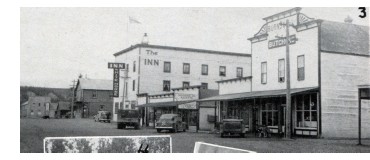 The thriving community of Whitehorse offered very little in the way of entertainment outside of a small theater and the post athletic field. As numerous young ladies arrived daily from the states and parts of Canada to take up employment in the administrative offices of the various construction companies with their respective office headquarters in this vicinity, the situation warranted the expansion of a broader recreational program. Each company, both Army and civilian, endeavored to hurriedly transform a building in their immediate area into an impromptu dance hall and invited the girls to attend various nights throughout the week.
These dances did not, however, meet with the approval of the girls, as not only were the different floors rough, sticky and uneven but the manner in which the
dance as well as the men was conducted, was very sorrowful and caused much unfavorable comment. Thus when word was circulated around that the 140th was throwing a shin-dig, the girls were more or less skeptical in attending the festive occasion, but through the persuasion and fast talking of Bob McDonald, Roy Lee, Don Brower and Charley Walker, forty girls promised to attend.
As the girls arrived on the designated night, they were greeted with a pleasant surprise upon entering the building picked for the dance. The building usually used for the mess hall consisted of two Neison huts built end to end and was chosen for
the Dance Hall, the floor almost completely covered with Masonite (unknowingly donated by a nearby construction company) was waxed and polished to a mirror like finish, furnishing 1600 square feet of dancing space. Long multi-colored crepe paper streamers, closely interwoven, gave the effect of a false ceiling and two fir covered lattice archways at either end of the building added a very original touch to the setti A large yellow moon shining from behind the fir boughs was practically the only means of illumination and caused the entire hall to possess a very romantic atmosphere.
A rhythmic seven-piece orchestra from Sector Headquarters furnished soft,
dreamy waltzes for those who preferred that type of dance and also really turned the heat on for the "Hep-cats" to swing and whirl. All the men were attired in freshly pressed uniforms and were as sleek and smooth as any "wolf" in the north. The first dance proved to be such a success that a series of dances followed which were usually held each Tuesday night.

The shrill blast of a whistle echoed through the still morning air of August 6, which was followed almost simultaneous with the loud clear call of "Fall in" and left us no doubt but it was our top kick Sgt. Argo calling a formation.
A formation at this early hour, especially on a Sunday morning grasped us with wonderment, "What was up?" After the last man had dazedly reached the formation, we were given "At Ease" and informed that the orders had finally been received from Headquarters that the 140th was to proceed on to their original destination, Big Delta, within the next few days.
Forty men were to board a transport plane, fly ahead to Fairbanks and make the preparatory arrangements, while the rest of the company would board one of the
river steamers and proceed to Circle, Alaska, where they would be met by trucks driven by the men who had flown ahead. The reason for this means of transportation was that the road was impassable and a drastic measure existed on the other end of the highway to haul supplies and equipment to the units stationed in that sector.
Receiving the orders to pack, we were dismissed and each one of us endeavored to pack his belongings. The one whom is outstanding and out-classes all others in being a collector of everything from an antique radio to an old cat hide is Mike Torres, and thus when packed, three footlockers plus three barrack bags were needed to
transport his menagerie of trashable items. In all sincerity Mike will declare that everything in his possession is of a worthwhile purpose.
Under the supervision of S/Sgt. Cooper, the men to fly ahead boarded the two planes on the evening of August ... and the following morning at 2:00 a. m. the steamer "White Horse" slowly churned her way down the Lewis river with 68 men of the 140th
aboard.
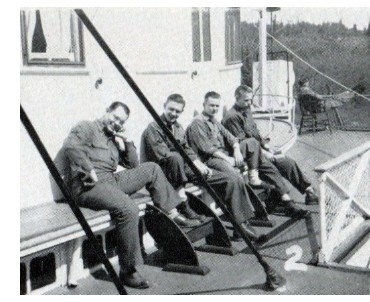 As the golden rays of the morning sun, reflecting across the surface of the blue water of Lake LeBarge and shone into the two-man staterooms aboard the vessel, we opened our eyes and pinched ourselves to see if this were all a dream. Waiting for it to fade away, but finding it a reality, we lay, dozedly, trying to get our bearings when the sound of a soft musical tinkle floated through the brisk morning air, our stomachs told us it was first call to chow.
To sit before a table with its snow white table cloth, array of silverware, with waiter service and ponder over the meal's menu, certainly was not the Army way we had been accustomed to, but it met with 100% approval from us all.
After chow, the various deck chairs were soon occupied and the boys lounged around, leading the life of Riley. Scenic grandeur that held us in breathless amazement greeted us around the hundreds of sharp turns in the course of the river. Tall towering rocky ledges, swift gushing streams falling hundreds of feet from the crest of snow-capped peaks, broad expanses of gleaming white sand bars stretched far into the river, forming dark shady lagoons among the ferns along the edges of the river.
As the end of the first day drew to a close and the soft shimmering glow of the big moon casting its beams through the lazy white clouds overhanging the still waters of the river, the "White Horse" moved silently on into the night, a slight breeze blowing with millions of stars overhead, caused a perfect setting for an atmosphere of song, and under the leadership of Prieto, a tenor and master of the guitar, the boys indulged in a hearty song fest. As the words of God Bless America drifted out across the water, it was indeed clearly understandable of "What we are fighting for."
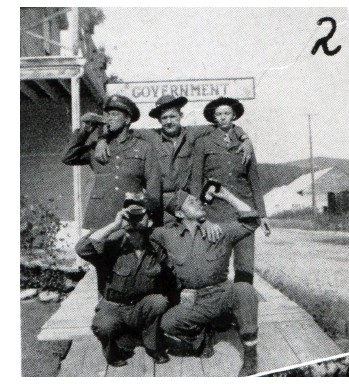 One of the highlights of the trip was during the chow of the second morning when the Steward notified us that the boat was about to enter Five Finger Rapids. Leaving the table, we rushed out to the rail of the second deck and the rapids were only a few hundred feet away. Gradually the boat increased speed even though the Captain reversed the wheel on the stern, the boat when reaching the center of the rapids, went through like a shot. Not only was this exciting but also it was really an art the way the Captain of the boat was capable of piloting such a large craft through such a narrow passage.
On the morning of the third day the sight all of us longed to see, lay ahead, The Historic Dawson City. The boat docked and within a few moments every man was eyeing the old frontier buildings, left standing since the gold rush days, through the reflectors of his camera.
The Pearl Harbor Beer Parlor was soon swamped with the guzzlers of the 140th who longed to dampen their tonsorial tract with a wee bit of thirst quenching beer. As there was a large supply on hand, it was not rationed and given to all who cared to buy at the price of one-half buck for one-half quart. Soon the entire city echoed once again as it did in days of old with a wild, yowling carefree crowd. A number of the boys
ventured out into the nearby hills and were taken on a very interesting tour of a gold dredge, while their buddies proceeded to see Dawson City in a very "rosy glow."
The day passed quickly and our equipment was placed aboard another boat, the "Klondike," which would continue on to Circle. The time for sailing was called and by frequent blasts of the ship's whistle, the boys drifted back to the boat from the dim, damp alley-ways of the wharf. Practically all showing the effects of having had a wild and frivolous time while ashore. As the clock struck midnight, it is an amazing fact but all
were aboard, some rather roughed up a bit, but all never the less and with an Alhoa done in true Yukon fashion, the first Yank soldiers of World War II to be in Dawson City were bid farewell, pleasant journey, and in a few cases a hearty kiss and a hug by the fair lassies of the city.
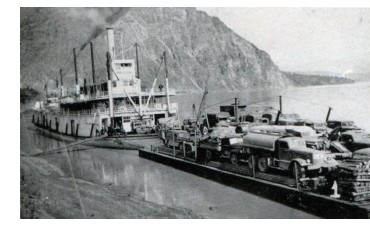 About ten o'clock the following morning, the Steward of the "Klondike" pointed out the boundary line which separated the Yukon territory from Alaska. It was a deep ravine between two jagged mountains.
In the mid afternoon of the following day, again a very outstanding scenic view was revived as had been so many times in the past few days. The river narrowed down to a few hundred feet from bank to bank, both sides were towering, sheer cliffs. What made this an exceptional sight was the geological formation, as approximately every twenty feet the texture and color of the sand would change, and due to the reaction of the wind and rain through previous years, had worn the sand until it greatly resembled the carvings by the ancients. It was so uniform, a truly fine example of Nature's craftsmanship.
On the evening of the second day, as cat calls drifted out across the water, we knew the rest of the company was waiting on the bank at Circle.

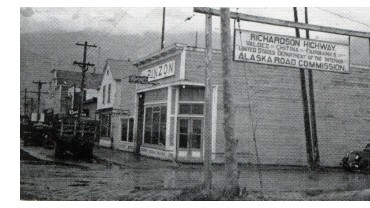
The key to the transportation problem in the northern sector was solved with the arrival of the 140th. AIl summer hundreds of tons of supplies, material and equipment, a necessity to the completion of the highway, had been unloaded from the ships at Valdez and piled on the docks awaiting transportation north. The junction of the Richardson and Alaska highways, ninety miles south of Fairbanks, warranted the construction of our new station. The initial plans of this camp site facilitated the transfer of troops, equipment and supplies and therefor gave us access to the three essential routes of transportation.
Forty-two trucks were assigned to their individual drivers who endeavored to give them all an impromptu overhaul due to the carelessness of the 477th drivers who had previously driven them. The following week found nearly every truck, some of which had looked hopeless, rolling hell-bent toward Valdez.
The officials at Headquarters in Fairbanks are quoted as saying that "a three-month period of steady hauling existed for fifty trucks out of Valdez," but were they surprised when the 140th finished the job in six weeks with thirty-five trucks.
A letter written on November 6, 1943, by Lt. Colonel Gerald R. Tyler, District Engineer, Corps of Engineers, said in part: About August 1943, vessels loaded with much needed building materials and equipment began arriving in the Port of Valdez. Extravagant promises had been made by civilian truckers who stated that they would be able to haul more than the total amount of tonnage which this office expected to receive through Valdez during the current construction season. It soon became evident that these
civilian truckers would fall short of the promises that had been made by them, as they at once began having labor troubles and breakdown of equipment,since most of their equipment was too light to stand the rough roads over which it was necessary to travel. The assistance of Major B. Souder, QMC, then Officer in Charge of the Fairbanks Division of Alaska Highway, was solicited. During forty-seven days in August and September, the organization over which he had control hauled 1,198,695 ton miles of freight from Valdez to the various projects assigned to this District. This amount is in addition to the hauling which was and is still being done by the QM Truck organizations from Fairbanks railhead to the various job sites..
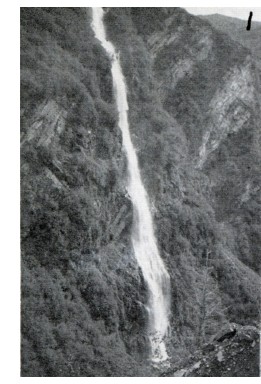 The run to Valdez easily surpassed any previous assignment that we had experienced as it could be accurately estimated that seven hundred and forty-two miles would have to be covered to make a round trip to Valdez.
The maintenance on the Richardson highway was non-existent prior to the arrival of the U. S. Engineers and a road that had once been black top surfaced in the past was nothing more than a series of chuck holes. The peak in the grueling test of trucking was driving both ways over Thomson Pass. For ten miles the road wound treacherously down the mountainside. Narrow horseshoe turns without a single guard rail to guard one against disaster if you drove too close to the outer edge, where a thousand-foot drop existed to the roaring river in the bottom of the Keystone Canyon below.
Civilian as well as Army trucks were in operation and thus there were traffic problems, as well as those of driving conditions, to constantly cope with.
The ever present rain and fog added the perfect touch for a truly hazardous trip. Of the numerous water falls along the route the two that were most outstanding were Bridal Veil and Horse Tail falls, which were seen from the bottom of the canyon, and thus set a perfeet picture for the "shutter bugs" delight and were snapped from the various angles of the camera fans' choice.
The thriving metropolis of Valdez offered very little in the way of relaxation and amusement for the men in service and every man was ready to return as soon as his truck was loaded, regardless of his exhausted condition. However difficult the trip, the ever-changing panorama and scenic grandeur relieved the monotony of the tiring hours behind the wheel. Numerous placid lakes and streams bordered the highway on either side.
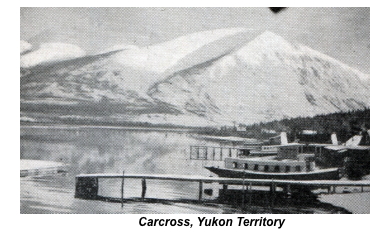
 One of the most outstanding of the lakes to draw one's interest was Summit Lake, located about half way between Valdez and Fairbanks. Due mainly to the marshes which completely surrounded the lake and the mossy tundra beneath the water gave the entire lake a brilliant emerald color. The water itself was crystal clear and thus cast off a mirror like reflection of the cloud formations overhead. An abundance of duck and moose were ever present and it was indeed a sportsman's paradise.
Also one of the perfections of nature which proved very interesting were the peculiar geological formations caused by the blending of color of the mineral deposits which gave a rainbow effect to the entire mountainside. One of the foremost glaciers in
this section was Muir Glacier, widely known for its immense size, shape and beauty and also the ever present danger of the yawning cravasses caused by the continuous movement of the large glacial body.
Many stories and articles have been written concerning the colorful beauty of the Northern lights, but no verbal description could ever convey the beauty of this phenomenon and its confusion of rapidly changing colors in the Arctic heavens.

As practically all the major portion of supplies and material that had previously been piled on the docks at Valdez had been hauled north, and trucking had been reduced to merely routine work, the need for the presence of a truck company in this area was over; it was an obvious factor that the job of the 140th on the Alaska Highway was finished.
As is always the case, those "latrine" rumors were continually circulating through our area. One of the less fantastic which had the ear marks of being both practical and probable and also somewhat verified, was that of the return of the 140th to the States. The rumor materialized shortly afterward and we made ready to return.
On the morning of October 3, 1943, twenty-four trucks loaded with equipment and personnel rolled southward. The condition of the road was excellent and the convoy proceeded to White Horse at a much more rapid rate than had previously been anticipated.
It was on the last leg of our journey by truck, fifty miles north of
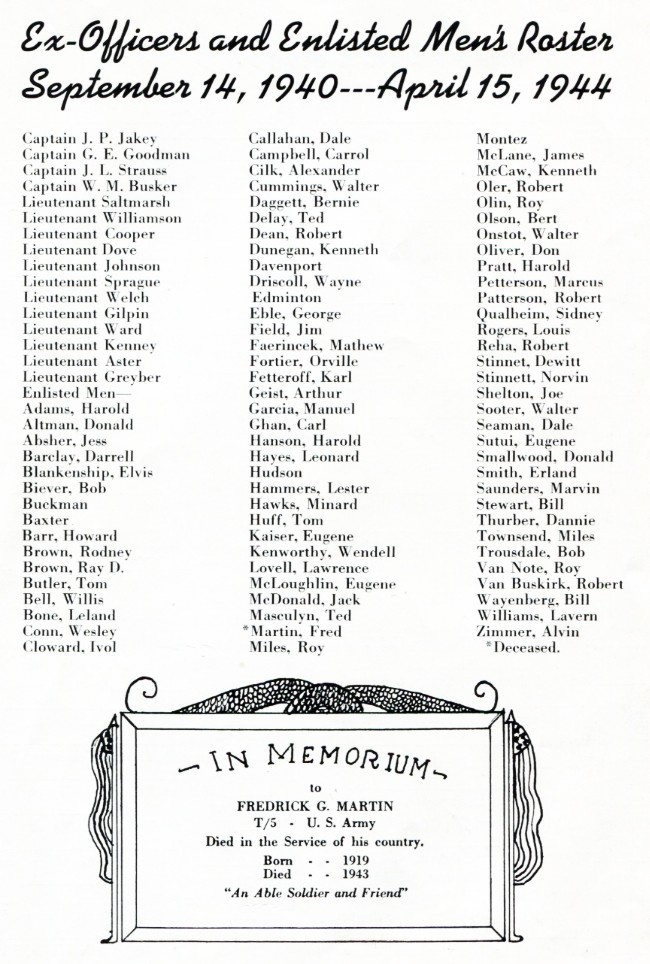
White Horse, that we met with our first and only casualty while in convoy in foreign service. It was that accident which took the life of Fred Martin, one of our able cooks and a grand fellow.

Arriving in White Horse on October 29th proved to be an asset to most all of us, as our old liquor permits were still good, thus being able to purchase a 26-oz. crock of spirits, which served a dual purpose by washing away one's troubles and also furnishing that real lift as only spirits can do. Our stay in White Horse was brought to an end after the elapse of two weeks when transportation facilities were made available.
 The early dawn of November 10 found the engine on the White-Pass Yukon railway puffing laboriously as it pulled the long line of coaches filled to the maximum capacity by civilian workmen and also by the personnel of the 140th enroute to the States. It was indeed a happy group of boys who sang their way from White Horse to Skagway. In the early evening, as the train pulled into the station at Skagway and stopped, all of us were only too glad to unload, as the cramped quarters of the coaches had become very monotonous.
Inevitably it has rained, regardless of the time and place the 140th has moved in the past and this was no exception, as a terrific downpour greeted us as we stepped off the train, thus confirming the old saying that smoke follows beauty as water follows the 140th.
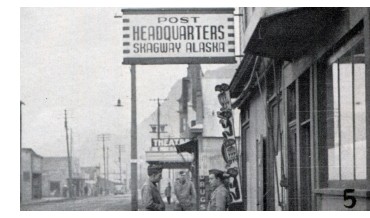 Our temporary quarters consisted of three Neison huts, located a short distance from the main "drag" of the city, thus simplifying the long homeward trek in the wee small hours of morning were one to become slightly inebriated from patronizing the innumerable taverns and bars which made up the majority of the business establishments. Although a number of the men limited their activities solely to endeavor to drink the town dry, the remainder of the company visited the famous "Pullen House and Museum." This
house was the original gambling casino of "Soapy" Smith, the foremost gambler and racketeer in all the northern country during the gold rush days of '98. The museum was composed of all the items and belongings of this gambler, pictures of all types, and very rare pieces of pottery, metal work, and other antiques gathered from all sections of
Alaska and the Yukon.
Our temporary quarters consisted of three Neison huts, located a short distance from the main "drag" of the city, thus simplifying the long homeward trek in the wee small hours of morning were one to become slightly inebriated from patronizing the innumerable taverns and bars which made up the majority of the business establishments. Although a number of the men limited their activities solely to endeavor to drink the town dry, the remainder of the company visited the famous "Pullen House and Museum." This
house was the original gambling casino of "Soapy" Smith, the foremost gambler and racketeer in all the northern country during the gold rush days of '98. The museum was composed of all the items and belongings of this gambler, pictures of all types, and very rare pieces of pottery, metal work, and other antiques gathered from all sections of
Alaska and the Yukon.
Five days passed quickly and the order was received that the ship, the
"North Sea" was tied at the dock, waiting to transport the company and its equipment to Prince Rupert. Boarding the ship in the mid-afternoon of Nov. 14, our original plans of every man being able to go first-class went up in smoke when it was found that two-thirds of the company would have to be quartered in the Steerage, much to the disappointment of the company as a whole. In contrast to the rest of the ship the steerage was nothing more than a suffocating, dingy hole. Three tiers of bunks extending from the floor to the
ceiling in such a confined space that it was very difficult to wend ones way from one end to the other. The only means of ventilation was that of a hatch door atop the ladder at either end and which were constantly kept closed, thus every night was spent in restless sleep.
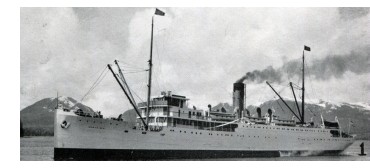 Those of us who were lucky to go first-class had entirely different
accommodations that were indeed a luxury, consisting of two-man staterooms. The meals were
served in a modern dining room, while in the steerage the boys ate below and had no choice other than that chosen by the Steward for the day.
Those of us who were lucky to go first-class had entirely different
accommodations that were indeed a luxury, consisting of two-man staterooms. The meals were
served in a modern dining room, while in the steerage the boys ate below and had no choice other than that chosen by the Steward for the day.
A number of girls, who had recently finished their labor contracts to work in Alaska, were enroute home, were among the civilian as well as Army passengers aboard the ship and added much gaiety, laughter and an occasional partner for those of
whom did not like to see those lovely romantic nights go to waste.
The ship offered a very nice lounge room equipped with a grand piano and
one of the ardent songbirds in our company "extinguished" himself as a singer. (Maybe the piano needed tuning).
The second day out the ship's Captain issued orders pertaining to a lifeboat drill as about four hours of open water would be crossed. The route we had been traveling was the inside passage. When the resounding blast of the ship's whistle echoed three consecutive times, everyone donned a livesaver jacket in double time and stood near the life boat or raft to which they were assigned. The strip of open water was constantly patrolled by the Coast Guard but there was always the possibility of a stray mine or a
lurking submarine.
Upon reaching the open sea the water became very rough and choppy, causing many of the fellows to fully appreciate and understand the definition of the two words feared by the dry land farmers, that of sea sickness, but as the ship neared the channel again, the water became calm and everyone returned to normal (SNAFU).
The "North Sea" docked at two ports where it was permissible for us to go ashore, first at the fishing town of Petersburg and second at the city famous for its salmon industry, Ketchikan. One of the most interesting experiences while our stay in Ketehikan was the excursion through the warehouses, where our eyes bulged out as we saw
7,000,000 pounds of frozen fish stacked like cord wood.
All along the route of travel, usually late in the afternoon, schools of porpoise could plainly be seen swimming in the wake of the ship.
After three days and two nights aboard the ship, we entered the harbor at Prince Rupert and docking, changed the mode of transportation to that of a railway train which took us to the Army Post at Port Edward, about thirty miles west. After we had disembarked from the train, a shave-tail (origin unknown) ordered us to follow him and
he would direct us to our barracks and messing facilities. Expecting to find the area near the station, we picked up our equipment, which consisted of a barracks bag, field bag, gas mask and rifle, and started to walk, walk and still walk.
This long period of walking with such a heavy load brought forth many grumbles and when the Lt. kept constantly bellering for us to close it up, the grumbling increased to a clamorous racket with numerous remarks cast directly at our would-be
associate, who was setting an extra fast pace, as he only had his mean disposition to carry.
After we had arrived finally at the summit of the ridge, which any man will swear is a good ten miles from the station, we were marched into a nearby mess hall and delivered a weleoming speech by our very peeved officer. His speech was intended
to be along the lines of military courtesy due a man of his standing, rank, etc., etc., and etc., but in place of silence, he was greeted with a series of boos and laughter and the madder he became the more the laughter until he considered that we were just a bunch of (censored) and it was obvious that the feeling was mutual, he left us holding no regrets that we would soon be moving on from that post.
This area was the first and only area where in order to walk from one point to another one was forced to use a sidewalk, to take a shortcut would lead to disaster by the numerous soft muskeg of the entire terrain. The Deacon found this to be very much the truth as he learned through experience by floundering around in the muskeg half the night.
Late the next afternoon we once more boarded a train and started the last
and final stretch of our journey home, arriving in Tacoma on the morning of November 22, and detraining at 9:00 a. m.

The units listed below are cited for meritorious conduct in the construction of the Canadian-Alaskan Military highway during the period March to October 1942:
- 18th Engineer Combat Regiment
- 35th Engineer Combat Regiment
- 93rd Engineer General Service Regiment
- 95th Engineer General Service Regiment
- 97th Engineer General Service Regiment
- 340th Engineer General Service Regiment
- 341st Engineer General Service Regiment
- 73rd Engineer Light Ponton Company
- 74th Engineer Light Ponton Company
- 133rd Quartermaster Truck Company
- 134th Quartermaster Truck Company
- 140th Quartermaster Truck Company
- 141st Quartermaster Truck Company
- 428th Engineer Dump Truck Company
- Company D, 29th Engineer Topographic Battalion.
- Company A, 648th Engineer Topographic Battalion.
- Sector Headquarters and attached Army Air Forces, Corps of Engineers, Medical Department, Ordnance Department, Quartermaster Corps, and Signal Corps Detachments.
To download a copy of "About Face," click here (pdf, 54 MB).