During the early davs in the Klondike, when thousands were crossing the
summit on foot, and the Yukon river furnished the only means of transportation from Lake Linderman to Dawson, the main obstacle to navigating the entire distance was found at Miles canyon or the Whitehorse rapids. That fact alone guaranteed the building up of a settlement in the vicinity of the rapids and brought that portion of the journey into wide repute.
Shooting the rapids with scows, boats, canoes and steamers was accompanied by all the excitement and danger which even daring pioneers, who are always
looking for the spice of adventure to be combined with their journeyings, desired. The less venturesome, though, dreaded the Whitehorse rapids with feelings of fear and awe.
EARLY SETTLEMENT.
Enterprising men came along and saw the chance to make money by constructing a tramway along the river bank, by which means the inexperienced boatman or timid "musher" could have their loads of supplies, hauled around instead of "shooting" the rapids.
This was really the foundation of the town of Whitehorse, although the present site is some distance removed from the north end of the canyon or rapids.
Later the companies that had built stern wheel steamers to ply on the lakes and river recognized that Whitehorse rapids was to all intents and purposes the head of navigation, and therefore established their headquarters at the present townsite. In 1900 the railway company built through from Lake Bennett to Whitehorse, thereby guaranteeing such a permanent settlement as encouraged hotel keepers, merchants and other business men to erect buildings suitable for the requirements of their respective business ventures.
The foregoing is in brief the early history of the present town of Whitehorse, which has gradually grown from a small hamlet of tents to the substantial dimensions of today, with a resident population of about 1000 people and a floating population during the summer months of several thousand.
But Whitehorse has other claims for prominence besides that of location at the head of navigation. The most prominent is the fact that the situation of the town is a central one in a district where the mineral resources are each year becoming more important and are attracting greater attention from mining operators, prospectors, and that vast army of mining engineers, geologists, metallurgists, and mineralogists who are so vitally interested in the mining industry.
MINERAL RESOURCES.
The mineral resources comprise a zone of about 16 miles in lengih (so far
as its limits are at present known), containing many deposits of copper-gold ore which is situated adjacent to the town of Whitehorse; an extensive area of coal measures containing several workable seams of good coal within 20 miles of the town; deposits of silver-gold-lead ores within easy access of the town and a vast area of placer gold bearing ground on the creeks in the Kluahne, Alsek and Kuskawalsh camps, situated from 100 to 200 miles north-westerly and westerly from the town.
The last named of the mineral resources will be described first in this article, as they are at present attracting much more attention than any other recent discoveries, either in the Yukon or Alaska.
WHITEHORSE PLACERS.
The first discovery of gold-bearing gravel in these camps was made in July, 1903, on Ruby creek and its tributaries, about 150 miles from Whitehorse, which is the nearest mining recorder's office. The discovery, which, by the way, was made by Skookum Jim and Dawson Charley, two Indians, who were really the discoverers of the
world-famed Klondike, was naturally followed by a stampede of prospectors, ship carpenters, business and professional men, clerks and, in fact, representatives of all vocations from Whitehorse, with a goodly number from Dawson, Skagway and other points. By the time the stampeders had staked claims, returned to Whitehorse and recorded, other gold bearing creeks were discovered; and consequently several stampedes took place. Owing to this fact, but little work was done.
True, Bert Fowler, owner of 32a on Ruby creek, sank a hole to rimrocks on
his claim, from which he took out gold dust to the value of about $300 according to his own reports, and C. Racine sank on Twelfth of July creek to a depth of 27 feet without reaching bedrock.
Other prospectors washed out gold by panning the gravel on several of the
creeks. The autumn set in, though, before many material facts had been determined about the newly discovered creeks.
During the last days of October Messrs. Smith, Bone, Ater and Altermore arrived in Whitehorse one Saturday night, bringing with them 40 ozs. of course gold (this, by assays made in Seattle and Vancouver later, proved to be worth $18 per oz.), which they had washed from rimrock on a creek named by the discoverers Bullion, situated some 40 miles westerly from the Ruby creek camp.
Of course, this started another stampede of equally as large proportions as any of those during the summer, notwithstanding the fact that the winter season, with its extreme cold and heavy snow storms, was rapidly approaching.
As a result of this stampede, Bullion creek was staked from its mouth to its source. Sheep, Metalline, Multi-Metal, Vulcan, Kimberley, Telluride and several other creeks in the near neighborhood were discovered. From all of these prospects of varied richness were reported, and stampede followed stampede until at the present time over 2000 claims have been recorded, and it is estimated that about 300 men are scattered over the vast area which comprises the Whitehorse placer district. All of these have taken in supplies sufficient to enable them to remain on the creeks for several weeks, and thus afford them an opportunity to prospect their claims by sinking to bedrock, or where the water prevents that, to at least reach rimrock on one or other of the limits of the creeks.
PRESENT CONDITIONS IN PLACER CAMPS.
To summarise the conditions in the new diggings:
First - It has been demonstrated by the work done by several prospectors in their endeavors to reach bedrock that the frozen zone is shallow, and below that water runs with so swift current that in even the most extreme cold weather it will not freeze. Consequently the creeks are propositions for summer work and not "winter diggings."
Second - That drain ditches will be required to carry off the water and enable miners to work in the summer.
Third - That it is quite possible, because of the heavy fall in the creeks, to run drain ditches, which if many instances can be successiuily excavated within the limits of one claim. But in cases where such cannot be successfully done then the same results can be obtained by the co-operation of two or more claim owners.
Fourth - That the area covered by the creeks known to be gold-bearing from tests made by sluicing and panning is so vast as to comprise at least 100 miles square.
Fifth - That from reports brought in by prospectors this vast area promises to contain extensive bodies of gold-bearing quartz, also workable seams of coal and deposits of bitumen. Specimens of all have been brought into Whitehorse, from which analyses showing satisfactory returns have been made. But, of course, no systematic prospecting can be carried on during the winter.
Sixth - That many nuggets of native copper are found on some of the creeks, also that cinnabar ore has been reported.
Seventh - That the prospects for water, timber and dumpage are first class.
THE COPPER-GOLD ZONE
which is situated adjacent to Whitehorse is known to be about 16 miles in length, Its trend or line of strike is in a general northwesterly direction. But the lines of strike of the ore bodies often vary from this general direction a few degrees, thereby showing evidences of having been thrown out of the general trend by eruptive movements, which have caused intrusive dikes of granite, diabase, felsite and other igneous rocks to occur or else by lateral pressure.
The original formation or oldest rocks in this zone are of sedimentary origin. The sandstones and conglomerates which lie southwesterly from the copper zone are probably cretaceous, and in these rocks occur the coal measures. But the limestone which occurs in the zone is possibly carboniferous, although it is almost impossible to determine its age for the reason that the contact with the eruptive rocks has fully metamorphosed the sedimentary limestone and altered it to a crystalline. For this reason it is very doubtful indeed if any fossils can be found to designate the geological period to which it really belongs.
The deposits of copper-gold-bearing occur, in nearly every instance, at the contact between crystalline limestone and felsite, but sometimes, instead of felsite a massive garnetyte rock occurs in contact with the limestone, while occasionally diabase forms the contact with the limestone at which the ore is deposited.
PROBABLE FUTURE OF COPPER BELT.
The future of this copper-gold belt ore can at the present time be only estimated by a comparison between the geological conditions of the Whitehorse camp and those of other copper-gold ore producers, because the actual development work performed is limited in extent. The deepest workings are about 100 feet, and the ore body in that occurence shows persistency, with every indication of maintaining its continuity to a much greater depth. The comparison which is the most natural to make is between this camp and the camps on Texada island, which is situated in the Gulf of Georgia between the mainland of British Columbia and Vancouver island. The geological conditions are similar in both districts, and on Texada island the ore bodies have been proven in three mines to a depth
of 600 feet in each.
The prevailing type of ore in the Whitehorse district is bornite, carrying gold and silver values with the copper.
SHIPMENTS OF COPPER ORE.
Up to date about 500 tons of ore have been shipped to smelters. The returns from this ore have been highly satisfactory in every case. The lowest grade ore so far shipped in 100-ton lot yielded $16 per ton in all values, and was shipped without sorting, The highest grade ore so far shipped was a carefully sorted lot of about 9 tons, and yielded 46.64 per cent. copper, 11 oz. silver and $2.50 gold per ton.
Shipments by ve been made from the Grafter, Copper King, Arctic Chief, Valerie and War Eagle mineral claims.
COAL.
The coal measures referred to earlier in this description have seams of variable widths, from 6 to 18 feet. Tests of this coal have been made on the locomotives of the White Pass railway to determine its steaming quality. These resulted very satisfactorily, as is shown by the certificates made by the engineers who used the coal.
Analyses of this coal made by chemists in Pennsylvania show it to be an
anthracite in character.
The veins pitch at a high angle from 70 degrees to vertical, and the outcroppings can be traced for at least 10 miles in one locality.
BUSINESS IN WHITEHORSE.
The town of Whitehorse consists of two principal business streets, on which some of the buildings are of such substantial character as make them the peers of many cities in British Columbia or on Puget sound.
The residence portion of the town is scattered over a considerable area, as is usual in new towns.
The depot, storage and office buildings of the White Pass & Yukon Route,
as well as the messhouses for employes and stabling for the accommodation of the stage horses, are all substantial structures and for the most part line the west bank of the Lewes or Yukon river for about half a mile.
The wharves and shipyards of the company have a very considerable capacity, and the latter, which comprise carpenter, blacksmith and machine shops, are so completely furnished as to enable the mechanics to make all repairs_necessary as well as build vessels suitable for the river trade.
The feet of the company, together with the independent boats which ply on the Yukon, number over 20.
The merchants of Whitehorse carry heavy stocks of outfitting goods, much larger indeed than such stores would carry in any city. The stocks are carefully selected to suit the character of trade, chiefly outfitting for the adjacent mining camps and road houses between Whitehorse and Dawson as well as between the former and the new diggings.
Whitney & Pedlar, Taylor & Drury, H. F. Sieward, H. J. Bigger, P. Martin, Fred McLennan, and R. Unsworth are the most prominent outfitters.
P. Burns & Co. control the meat business. The hay and grain business is carried on by R. Lowe & Co., P. Burns & Co. and Langholz & Nelson.
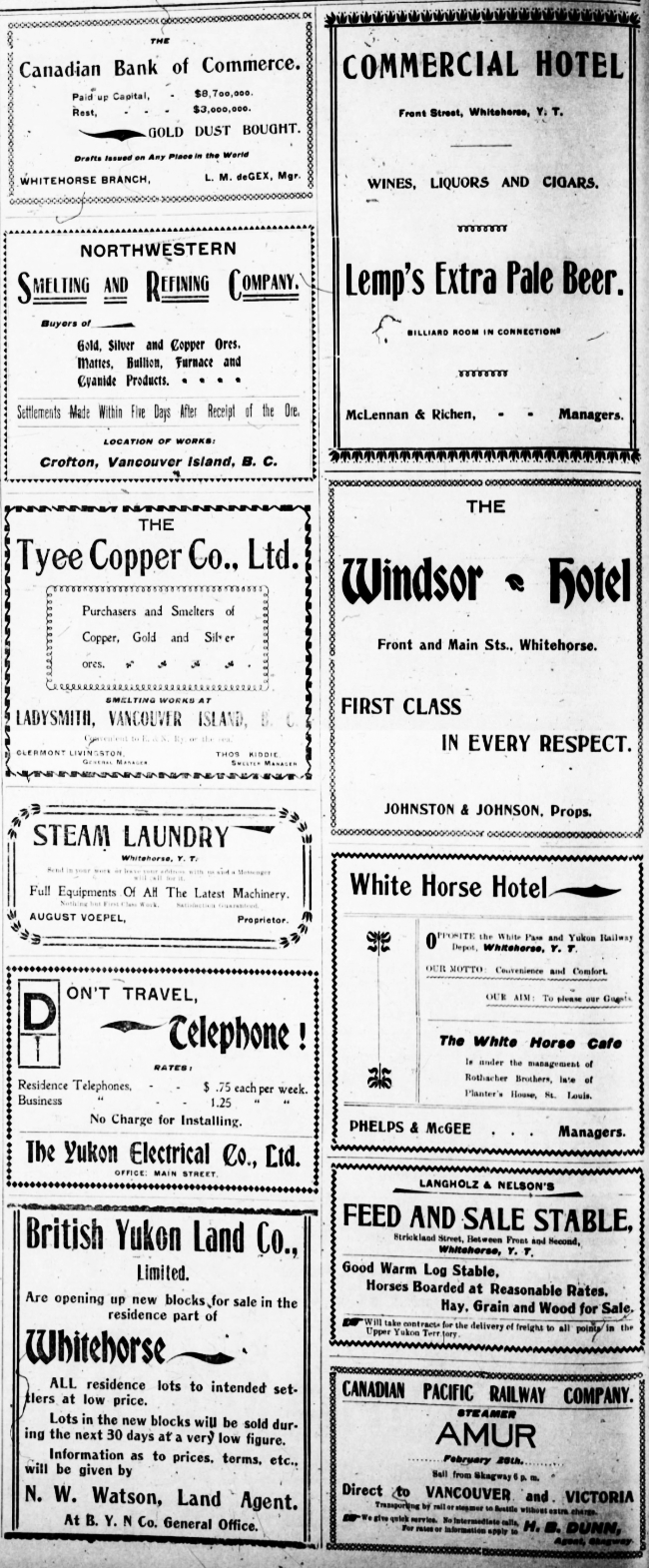
The Canadian Bank of Commerce is the only institution of that kind in
Whitehorse.
The fact that the town is lighted by electricity and that a well patronised telephone system has been in operation for the past two years speaks volumes
for the enterprise of the citizens as well as for the energy and foresight of the
Yukon Electrical Company which installed its thoroughly up-to-date plant in 1901.
All branches of business besides that of outfitting already referred to are represented by go ahead reliable firms. There are two first class drug stores, W. J. Stoddart, the jeweler, has a complete stock in his line, while the Bennett News Company carries an excellent assortment of all goods in that line besides fruits, etc. Barber shops and bath rooms, where every appointment is fully up-to-date, as well as steam and
hand laundries are conveniently located and saificiently numerous to accommodate a town of larger proportions.
The hotel and restaurant business is well represented by the Windsor,
White Horse, Commercial, Regina, Golden Eagle, Pioneer, Imperial, Dominion, Seattle, Arctic Cafe, Halbe Cafe, Windsor Cafe, White Horse Cafe and Royal restaurant. The accommodations are such as guarantee confortable quarters and good fare to all.
Whitehorse has the advantage of being the headquarters for "H" Division
of the N. W. M. P. and consequently the location for large barracks buildings as well as store houses, stabling, etc., because a force of about 150 men is maintained.
Religion and education have been both carefully fostered by earnest
clergymen and school teachers of ability and experience. The former is represented by the English (Episcopal) Presbyterian and Roman Catholic churches and tbe latter by the Public and Sisters' schools. The public school building was erected by the territorial government about 2 years since when Mr. A. E. Fisher was engaged as principal and Miss Middlemiss as assistant. The attendance averages about sixty pupils.
A general city hospital as well as one connected with the barracks ensure for the sick and injured equally as good treatment and nursing as they could get at any of cities on the Sound.