A Guide to Whitehorse
The History of Whitehorse
Mary Lake is located at 60° 39' 54" N., 133° 59' 22"W., map 105C/12.
Mary Lake has been a well-known recreation site since at least the late 1950s, when Scouts and church groups (mostly Catholic) used it for outings year-round, but its history goes back much further. The lake's name was originally Dugdale Lake, named for Dugdale Station on the White Pass & Yukon Route railway - it was located at MP 99.9, at the north end of the lake. Dugdale Lake gained some fame locally as the result of a placer gold strike in October 1913 - see this article.
The first pair of photos show aerial images of what is now Mary Lake in 1946 and 2026 - the two images show exactly the same area. Click on it to greatly enlarge it in a new window.

The lake somehow later became known as Ruth Lake (see my 2 blog posts exploring that), but then the Catholics apparently thought that it was inappropriate for Ruth to be connected with their outdoor activities and the name gradually changed again. Several cabins and a chapel were built, and in 1971 the Scouts used materials from the small cabins to build one larger building.
In 1976 the Scouts built an even larger and nicer building on their site. That new building allowed them to host their first Corroboree, and the following year the RCMP even flew 9 Cubs and their leader, Peter Benjamin, down from Old Crow for the event.
In the late 1970s, Girl Guides, the Whitehorse Archery Club, and the Whitehorse Choral Society are also noted as using Mary Lake for events.
Off to the northwest of the Scout and church camps, another camp was built. On August 1, 1966, tenders were called for construction of a road into a new minimum security corrections facility called the Wolf Creek Camp. By early 1967 it consisted of several trailers with a staff of 15 and up to 32 inmates. In June 1969 a wing of the camp started to be used for up to a dozen juvenile offenders, and the "Wolf Creek Training Centre" was soon entirely juveniles.
In the summer of 1973, Whitehorse was chosen to be the site of the first National Cadet Camp held by the Canadian military. For 10 years the cadets were housed at Yukon Hall in Riverdale and various other places, but in August 1983 the Department of National Defense spent $500,000 to convert what by that time was the Wolf Creek Juvenile Correctional Centre into a cadet camp. The camp and surrounding 460 acres of forest were leased from the Yukon Territorial Government for $1 per year.
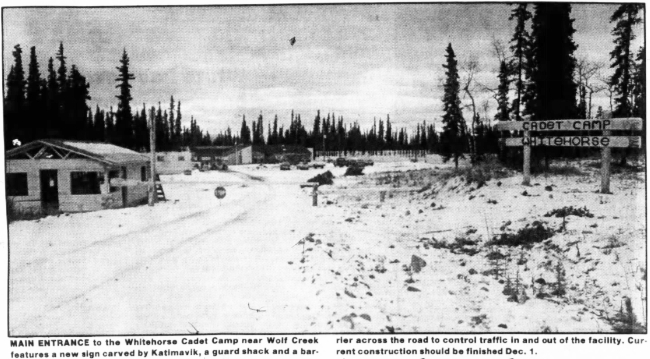
In 1986 the road from Fireweed Drive to the cadet camp was named Booth Road after Brian Booth, who was actively involved with the Air Cadet League of Canada, and was instrumental in the establishment of the cadet camp as well as the establishment of a Yukon chapter of the St. John Ambulance Association. In 1991 the cadet camp itself was named Boyle Barracks after Joe Boyle, who organized and funded a machine gun company made up of Yukon miners when World War I broke out in 1914.
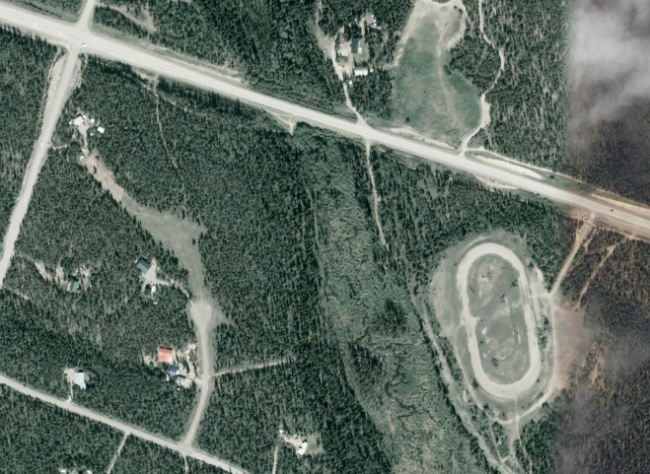
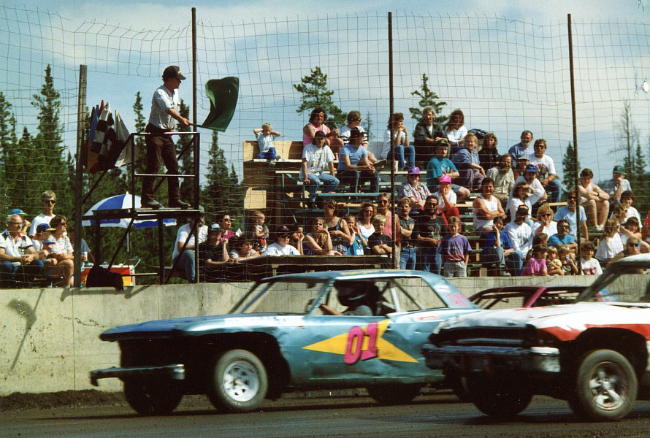
The area was also home to another form of recreation for over 30 years. The property that became the K.M.A. Speedway was first leased from the City of Whitehorse in 1970, by the Klondike Auto Racing Association (KARA) and later by the Klondike Motorsport Association (KMA). Races were held by KARA from 1969 (a year before the lease was signed) until 1989, and then by the KMA from 1993 until 2004. In September 2004 the speedway was closed by request of the City and the Territorial government, and the lease was relinquished.
Then in 1983 we come to the start of subdivision period:
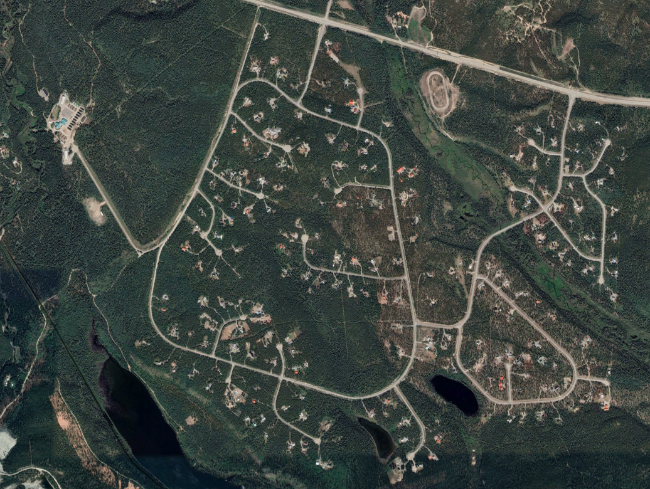
Boyle Barracks to the left, Mary Lake in the middle, and Cowley Creek to the right on July 20, 2021 (Google Earth).
December 7, 1983: "Mary Lake. That's the working name of one of the two new country residential subdivisions in Whitehorse planned by the Yukon government.
Mary Lake is the area first designated as Wolf Creek Stage III. Only Stage I has been built. Stage III is the area bounded on the west by the new cadet camp, on the east by the Klondike Auto Racing Association speedway, on the south by Whitehorse city limits and on the north by the Alaska Highway.
The area can handle a total of 140 lots of 1 - 1½ hectares in size, while retaining a six-hectare centre portion and the area adjacent to a lake known alternately as Ruth Lake, but better known as Mary Lake, for recreational use.
The route of the proposed Alaska Highway gas pipeline passes through the Mary Lake area, but the government has enough information to plan around it.
The area does not suffer from the lack of water that plagues nearby Golden Horn subdivision, but is similar to the Wolf Creek subdivision. There well depths vary, but the average is about 35 metres."
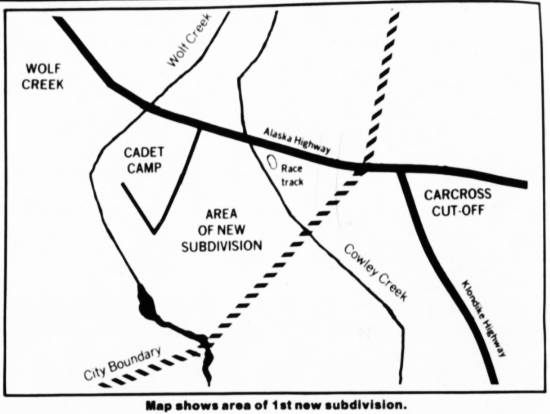
March 2, 1984: "Whitehorse planning board has recommended that city council accept Yukon government plans for a 100-lot country subdivision southeast of Wolf Creek.
Chris Knight, director of the Yukon government's land office, said that if all goes to plan the first phase of 59 lots in the Mary Lake Country Residential Subdivision could go on sale this fall.
The subdivision will consist of a ring road some 5.78 kilometres in length. Off of this will extend nine dead-end stub roads.
At the south, or farthest end from the highway, a number of lots will sit on top of the 20-metre escarpment overlooking Mary Lake itself, a long, narrow lake
from which Wolf Creek flows.
The area is criss-crossed with a variety of trails. In general, the
area has been designed so that some of these trails are where roads will be built, while other trails will separate areas of lots and be left for skiing. An attempt has been made not to have existing trails on planned lots.
The subdivision is cut in two from east to west by a 90-metre
wide strip reserved for the stalled Alaska Highway gas pipeline."
Read the entire article here.
May 2, 1984: "City council has agreed, reluctantly, to a territorial government request to increase the size of the proposed Mary Lake country residential subdivision on the south edge of town. With more lots, individual lot prices will come down by about $3,000.
The initial plans had called for the subdivision to eventually have 100 lots, though the government had looked at plans with as many as 150 lots. But Municipal Affairs Minister Dan Lang asked council recently to allow him to add more lots, because it would bring down the individual cost of lots.
The*estimated price of the subdivision is $1.53 million, territorial lands director Chris Knight told the city in a letter. That works out to $15,300 per lot with a 100 lots or about double what similar lots recently went for in Haines Junction and
Carcross.
The cost is blamed on the much longer roads required to reach the site, but is made up for by the 'high standard of design and amenities,' Knight said. The subdivision also has provision for recreational lands, such as a ball field — a feature not in other rural subdivisions.
Despite the continuing high demand for rural lots, Lang said recently he is worried the lots would not sell.
If the price was spread over more lots, the government reasoned, the price would be better.
Knight's office came up with an amendment to the plan that would add 30 lots in otherwise vacant areas, for a total of 130 - without having to add much to the
planned road system."
Read the entire article here.
May 9, 1984: A Tender Notice is published for "Clearing, Grubbing & Stripping, Mary Lake Country Residential Subdivision." On June 22nd it was announced that Gondor and Sons Ltd. had been awarded the contract, with work expected to be completed by July 1st.
May 16, 1984: "City council has agreed with a planning department suggestion
to name streets in the proposed Mary Lake country residential subdivision after Yukon plants.
Mary Lake is to be constructed this summer southeast of the Wolf Creek country subdivision.
Themes are common in Whitehorse - Porter Creek streets are named after trees, Riverdale's streets are named after rivers, Crestview uses lake names, Marwell uses the names of minerals, Takhini famous battles, Wolf Creek, Macpherson, part of downtown and the Hillcrest expansion use pioneers' names.
The main loop road in Mary Lake will be named Fireweed, while the short dead-end crescents will be named from a list including Aster, Bluebell, Buttercup, Cinquefoil, Columbine, Forget-me-not, Larkspur, Crocus, Sage, Salmonberry, Strawberry, Wildflower, Wild Rose and Wild Iris."
May 16, 1984: Providing more money for developing the Mary Lake subdivision is listed among the reasons for an additional $844,000 to the $2.25 million land development budget for Municipal Affairs.
July 11, 1984: "After nine years of living in schools, Yukon Hall, commercial
warehouses and hotels the Whitehorse Cadet Camp will formally open its own permanent home tomorrow morning.
The camp, located on a 186-hectare site on the Mary Lake Road near the Wolf Creek subdivision, consists of 22 log-cabin style buildings including barracks for the student cadets, barracks for the staff cadets, mess halls, wash rooms and administrative buildings.
Future classrooms and barracks are housed in tents for this summer but should become permanent structures in the next two years.
The territorial government owns the site and used to use it and a large building on it for the Wolf Creek juvenile facility.
August 10, 1984:
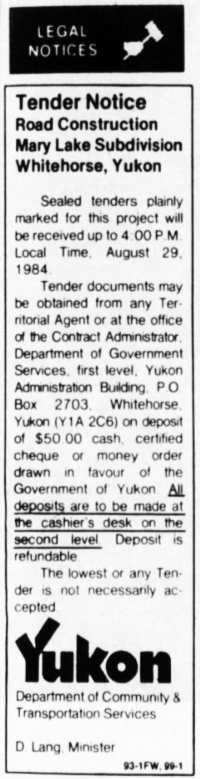
September 28, 1984:
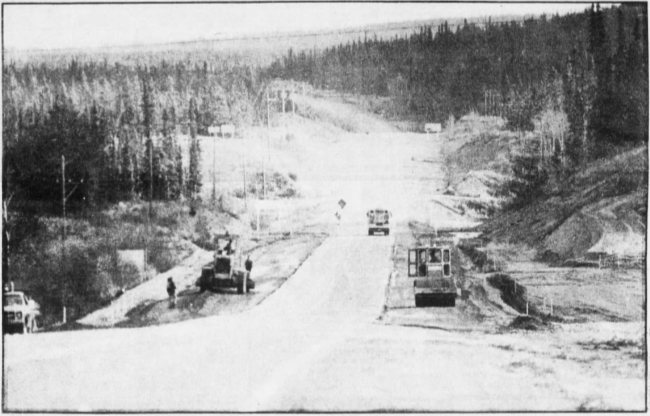 Crews prepare turning lanes on the Alaska Highway near the new entrance to the Mary Lake country subdivision, now under construction on the southern tip of the Whitehorse. The road work for the subdivision is to be done by October 26, according to Yukon government lands director Chris Knight. Phone and power line work will begin shortly. Lot sales are expected in the spring.
October 12, 1984: "Development of the Mary Lake subdivision could be completed within three weeks, weather permitting, says Yukon government lands director Chris Knight.
If weather allows the roads to be completed and power and phone lines to be strung into the 70-lot first phase of the 130-lot subdivision this fall, lots could go
on sale shortly.
But if the weather moves in and dumps a lot of snow on lots before prospective buyers get a chance to look at them, the sale would likely wait until spring - the originally-scheduled sale time.
Knight said the road work should be completed in another week, allowing people to drive in and look at the area. The weather has been kind, but could change
suddenly, he said, noting last October was much colder than this year.
The lots are expected to be priced in the $14,000 to $15,000 range, whether they are sold this fall or in the spring.
The government still hasn't started plans for the next subdivision, closer to town near McLean Lake. It's still waiting for completion of detailed mapping. Initially, the city had wanted both subdivisons developed at the same time."
The problems have, however, delayed the sale of the first lots from this fall until the spring.
November 21, 23 and 28, 1984: Geotechnical reports have come to light stating that there are major water and septic problems in the Mary Lake subdivision. When the government developed the Wolf Creek subdivision in 1977-78, the Vancouver geotechnical firm Golder-Brawner dug two wells in what would become the Mary Lake subdivision, then the Yukon government later drilled four more. Those six holes produced positive enough results to proceed. At this point, the government still says there are ways of dealing with the issues. On some lots, different approaches to septic issues may need to be taken, like over-excavating and backfilling with a coarser, grainier material.
December 5, 1984: "The federal government, which is responsible for health in the Yukon, says it may not be able to approve use of many of the lots in Mary Lake.
And a geotechnical consultant, whose report the territorial government has not made public, says the subdivision is not suitable for septic systems and should be serviced with expensive partial or total sewage service.
Richard Lawrence, senior environmental health office with the federal Health and Welfare Department, raises three problems with the subdivision - the problem made public two weeks ago of 75 per cent of the ground being unsuitable for conventional septic tanks, plus the lack of water and the quality of water.
Community Services Minister Dan Lang said the additional studies are being done."
December 12, 1984: "It would cost about $7,000 to have a well drilled in some lots of the Mary Lake subdivision - well over half the cost of the lots themselves.
Furthermore, the water would be relatively hard and high in mineralization content. It might also contain iron and manganese levels that surpass Health and Welfare Canada limits, and the reliability of the water supply would be questionable.
Those conclusions stem from a consultant's report on Mary Lake that the Yukon government has refused to make public, but which has been obtained by the Star.
The document also suggests that 75 per cent of the 101 lots are unsuitable for septic tanks because the soil is too tightly-compacted to let them drain
properly. That conclusion contradicts public statements by Community Affairs Minister Dan
Lang and land office director Chris Knight that only 20 to 25 lots wouldn't be any good for septic tanks.
The report urges a full or partial sewage system, which would be incredibly expensive to build."
This is from a very detailed half-page article.
January 30, 1985: "The Yukon government hopes to decide on the future of the troubled Mary Lake subdivision early in February and has ordered yet another study of the soil in the area.
The government has hired EBA Engineering to conduct drilling and soil percolation tests in the subdivision. After the tests end this week, EBA staff will examine them and give a report to the Yukon government's land office."
March 6, 1985: "Mary Lake is OK. 'With careful selection,' all the lots at the Mary Lake subdivision are suitable for septic tanks, a new soil testing report has concluded.
Yukon government land office director Chris Knight said some care will have to go into choosing a septic tank location on some lots. Community Services Minister Dan Lang says the lot sale will probably start in April or May so buyers can build throughout the summer.
The latest report, done by EBA Engineering of Whitehorse, contradicts the results of a report done last year that suggested 70 of the 101 lots were unsuitable for septic tanks because much of the soil wouldn't allow sewage to percolate quickly enough. That report also raised questions about the quantity and quality of the water supply, suggesting that deep, costly wells would have to be drilled on some lots.
In the latest tests, Knight said, a series of six-metre bore-holes were drilled in a random pattern throughout the area where glacial till soils, which usually
slow percolation, were in evidence. The soils were then sampled and classfied.
The report concludes that the ground is not uniform. Instead, it consists of random zones of the silt, mixed with sand and gravel which allow better percolation. The soils are consistent with those found at similar elevations throughout the entire Yukon River valley."
April 24, 1985: "City council has given final approval to a bylaw rezoning the
new Mary Lake subdivision from open space to zoning suited for the residential and recreational areas of the subdivision.
The decision clears one of the hurdles before the government could put the controversial subdivision's first phase on the market. The lots will now go on sale in a month to six weeks, after the snow has gone and prospective buyers can look at the lots."
July 5, 1985: "New rules introduced by the Yukon Government should offset the controversy that had delayed the sale of lots at the Mary Lake subdivision until today.
The controversy over water and sewer services in the area has stalled the first phase of development at Mary Lake, prompting the New Democratic government to introduce a new sale rule.
Last fall and winter there were conflicting engineering reports on whether or not conventional wells and septic tanks are possible in the subdivision. One report said special, expensive septic tanks would be needed. Another said standard septic systems are possible if they are carefully chosen. One report said finding suitable water
would be tough.
Government Leader Tony Penikett said his cabinet's response has been to offer a low-risk refund policy for buyers. It works like this. A person buys a piece of property and makes the required 20 per cent deposit. Any time up to 60 days later, the person can turn the lot back to the government and get the money back, except for $325 in application and administrative fees.
"That's really an acknowledgement of the public uncertainty arising from the consultants' reports," he said today in an interview. He said 60 days should be enough time for people to make a close study of their lot and investigate whether it will support a good well and septic system.
The government is handing out application forms for a July 19 lottery. Applications must be received back by the government by 5 p.m. July 18. The first person
drawn gets the first choice of the 58 lots and so on.
The government has also prepared an information package. It includes things like maps, outlines the conditions of sales, and specifies very clearly what sort of government services can be expected - for example, school busing will be provided upon demand, and the area gets fire protection, though it is a long way from the nearest firehall. It also outlines the debate over septic and water.
"There's strong advice in there that people should not site their house until they decide where to put their well and septic tank," Penikett said.
He admits freely that the government is taking a calculated risk. If water and sewer isn't a problem, it means all 101 lots should sell with no problem, meaning the government would recover its entire development costs of just over $1 million.
Lot prices in Mary Lake were set by cabinet Thursday, based on development costs, at between $10,950 and $12,250 each. Prices vary depending on size (lots range up to two hectares). Three lots that already have wells, drilled during the government's tests, are priced in the $19,500 to $20,130 range.
But if the warnings are right, the government could get stuck with a bank of lots that can't be sold and for which development costs cannot be recovered.
"There are some consequences if land gets turned back," Penikett said. What happens then?
Penikett said his government will cross that bridge if and when it has to. One proposal might be for the government to look at each lot and figure out how to put
in a well and septic system, put them in, and put the lot back on the market. If that doesn't work, the government may just have to absorb a loss."
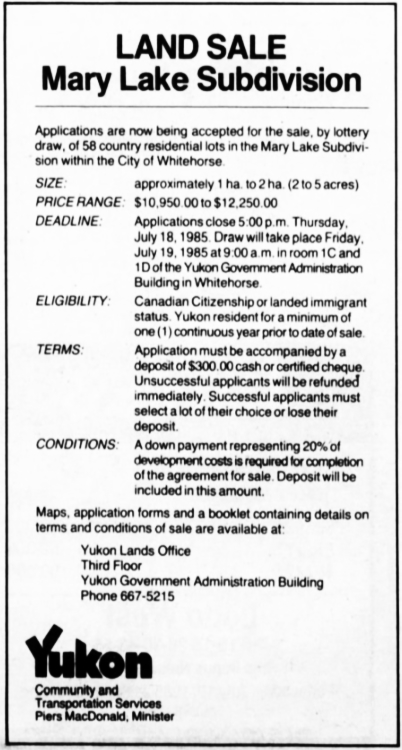
July 19, 1985: "The controversy over the Mary Lake subdivision appears to have affected lot sales. Only 28 applications were received by yesterday's deadline for the lottery for the first phase of the subdivision, which contains 58 lots.
In past lotteries for rural land, there have been far more applications than lots, but Mary Lake has seen questions about whether typical wells and septic tanks
are sufficient to provide water and sewer service.
The remaining lots are expected to go on the open sale market when the 28 applicants have made their picks."
October 11, 1985: The first Mary Lake home appears in the Star ads: "Superb Country Residence in new Mary Lake Subdivision. Features 3 bedrooms, large dining room, fabulous living room, large upstairs, wood heat, trees, land and more. Asking $94,900.00." The ad ran unchanged for 10 months.
November 15, 1985: The Yukon government has been able to sell only 35 of the 58 lots of the first phase of the Mary Lake country residential subdivision. The 45-lot development at the Golden Horn subdivision satisfied many of the demands for land, and a slow economy is affecting current land sales. Nevertheless, the government will install the roads for the second phase of the Mary Lake development in the spring.
April 16, 1986: A report on Yukon schools recommends 2 new schools in Whitehorse, one at each end of the city limits. The suggested location for the $5.1 million, 350-student elementary school at the south end is near the Mary Lake turnoff from the Alaska Highway.
June 20, 1986: "One of the Best Lots in Mary Lake Subdivision. Four beautiful acres on a greenbelt with a government drilled well on site. Road and culvert installed.
Cleared building site. Financing available at 12% interest. Asking only $24,900."
September 5, 1986: "The Yukon government is suing a Whitehorse engineering firm, saying it breached its contract by not ensuring the building of lots and roads in the
Mary Lake subdivision was done according to the government's specifications.
In documents filed with the Yukon Supreme Court, the government says
the engineering firm submitted a notice of completion Dec. 10, 1984 saying
all work had been done as of the previous Nov. 20. The government claims that not all the work had been done, adding that cul-de-sacs had been made too small and improper materials had been used. The government is seeking damages of at least $60,550."
January 7, 1987: "Bill Miller, the Yukon government's land development co-ordinator, said $200,000 has been budgetted to finish off the roads and services in
phase two of Mary Lake. If that work goes ahead in early July, as hoped, the final 43 lots of 101-lot country residential subdivision should go on sale late this summer."
July 27, 1987: "Protests from Mary Lake residents have upset a dog musher's plans to breed and train dogs on his residential lot in the rural Mary Lake subdivision.
The city planning board recently refused to grant [ ... ] a kennel licence for his property in Mary Lake.
Residents argued they don't want him to keep up to about a dozen
potentially noisy dogs on his lot. Lots in the subdivision average 1.6 hectares.
However, the planning board ruling doesn't actually restrict the number of dogs he can keep and he could still go ahead, albeit at more expense.
He's outside the built-up area of the city in which the city's normal limit of two dogs per home or up to five with a permit applies. There is no limit in country residential subdivisions, a bylaw enforcement official said today.
The advantage to the kennel licence is that he could have kept any number of dogs allowed under his licence without having to buy city dog tags for every single one of them."
July 27, 1987: "A group of residents from Mary Lake say they'll ask city council to legislate the number of dogs any one family can have in the country residential subdivision.
Dogs are becoming the key issue in the city's newest rural subdivision
as several people involved in raising dogs or running dog teams are moving into the area - about the only place where semi-rural lots are now available within city limits.
They say an additional problem is that Mary Lake is about the only rural subdivision in years sold by the government without a clause requiring prompt construction of a home. While most of the people running large numbers of dogs plan to build a home, residents say they've got reason to fear that some will buy the lots simply for their dogs and not to live on.
There are no kennels in Wolf Creek, where property was bought under laws that allow as many dogs as someone wants to buy licences for. But they also had rules requiring building of homes."
August 26, 1987: "The Yukon government has gotten tentative city approval for some changes in the road design in Mary Lake. After recent study work, the government wants to change the alignment of four roads in the uncompleted phase II area of the
country residential subdivision because of some engineering problems. It means changing some of the lots around too. The 43-lot phase II is expected to come on the market in early October."
April 25, 1988: Mary Lake Phase II lots go up for sale.
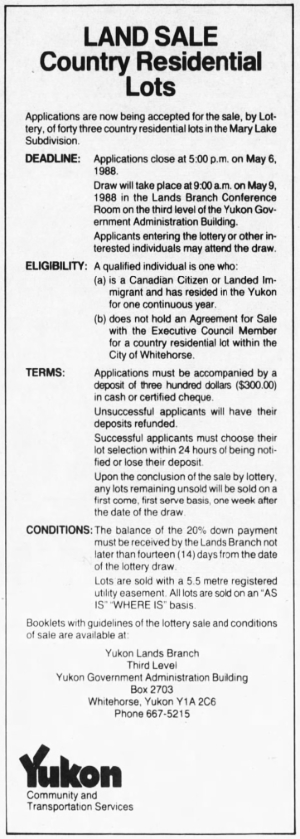
May 11, 1988: "More than 30 people gathered at the Yukon government lands branch
conference room Monday morning hoping their application would be one of the first ones drawn for the 43 country residential lots in the Mary Lake subdivision.
The department received a total of 93 applications for the lots, says
Lyle Henderson, land development coordinator with the government’s land development section.
The lots, including hydro and telephone service, sold for anywhere from $14,000 to $14,500; and the new owners are required to build within five years.
Today and Wednesday the lands branch will be telephoning the applicants in the order their names were drawn. Because of the way the lottery system works, a person
whose name was drawn 52nd may get a lot, while a person whose name was drawn 33rd might not, depending on which lots people selected.
The Mary Lake subdivision lottery is the first of three which will take place this summer. Several homestead lots at kilometre 144 on the Klondike Highway will go on sale at the end of the summer. In September, a lottery will be held for the lots in the Granger phase one subdivision in Whitehorse.







