
|





|
|
A volcanic eruption near Atlin, British Columbia, in 1898?
An Explorer's Guide to Atlin, British Columbia
Neogene to Recent volcanism in the Atlin volcanic district
Dateline: January 18, 2024.
On November 29, 1898, the Victoria Daily Times reported the eruption of a volcano that rivaled Vesuvius, about 50 miles from Atlin. Hundreds of articles repeated and embellished the story for months, but it wasn't true. Despite the large number of newspapers that published the story, only a handful reported that it had been false. Strangely, the Smithsonian Institution states that "No field evidence has been found, however... and the report is considered uncertain."
Five of the more interesting articles are reproduced below.
Victoria Daily Times, Tuesday, November 29, 1898.
To Rival Vesuvius.
Arrivals from Skagway tell of an active volcano about fifty miles from the Atlin mining district. So far it has been intermittent in its active stages, and the sight has been witnessed by but a few people. Rumors had been coming into Atlin and the surrounding country for some time that an active volcano was in frequent eruption about
fifty miles away.
The volcano is of more interest than appears on the surface, for only one
other mountain in that country has been reported before in eruption, and that only on a small scale. No name has as yet been given to the mountain, but the officials at Atlin are reported to be preparing to make a trip of inspection to the site in a short time, and they will undoubtedly give it a name.
The reported active volcano is said to be the second one in a string of four mountains lying fifty miles due south from Lake Gladys, all of which are reported to be at least 14,000 feet in height. The first report that the mountain was an active volcano was brought to Pine creek by a party of prospectors who were camped at the foothills of the mountain one night when it started to emit large clouds of steam and ashes. Molten lava ran down the side of the mountain in large streams.
Since that time at least a dozen different parties have reported seeing the mountain in a state of eruption, and the officials at Atlin at last became interested, with the result that as soon as possible a party of them will be sent out to make an investigation of the wonder. They will have scientific instruments along, and will be able to take data which will undoubtedly prove of much interest and value to science.
The Examiner, San Francisco, California, Wednesday, November 30, 1898.
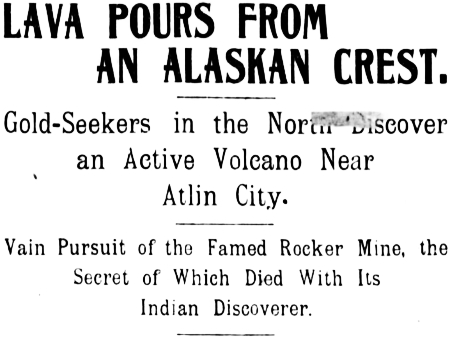
(Special Dispatch to "The Examiner.")
VICTORIA (B. C.), November 29. - Dr. W. D. Kinsloe and T. H. James, Denver mining men, with Colonel Hughes of Rossland, form a trio of just-returned northerners now in Victoria, who illustrate In their recent experiences and present intentions the pertinacity with which miners will follow a will o' the wisp. These three men went into the upper Yukon country by Teslin lake and were right in line for the Atlin lake country when the rich discoveries were made there. About the same time, however, they heard the fantastic tale of the lost Rocker mine, the standard romance and dream of the northern miner, and preferred to stake their season's outfit and labor on the relocation of this phantom treasure to developing the claims they had staked on Pine creek, but if they did not find the Rocker they found something they had not looked for: an active volcano, as the sequel will tell.
The report they had had of the lost Rocker was obtained from one of those to whom the Indian hero of the legend originally communicated his secret at Juneau years
ago, and was in effect that this red man, far back in the mountains beyond Long lake, had discovered a rivulet whose banks washed gold in such quantity that he had taken $20,000 out in less than two days. He and his squaw were working it industriously when a white prospector joined them and soon became one of the family circle. As days wore on the Indian became suspicious that all was not right between his wife and their white guest, and one day becoming assured of the fact, he killed both. Then he fled to Juneau to surrender himself, but taking many thousands in dust with him in partial substantiation of his strange story. The provocation, according to his own tale, was so great that the authorities declined to detain the avenger of his honor, and shortly afterward he died, refusing for any consideration to revisit the scene of the crumbling of his domestic happiness. Before he died, however, he described minutely to his friends the location of the mine. The directions given proved more satisfactory to Jones, Hughes and Kinsloe than they had to 500 or more others who had preceded them over the same ground on the same quest.
The mine, according to the Indian's story, lay close against a great glacier at the foot of an old volcano, the route to it being along Surprise and Long lakes. The directions of the discoverer were to paddle around the base of the volcanic mountain, passing six creeks and ascend the seventh, where would be found the abandoned Rocker and much gold. The glacier, the extinct volcano and the succession of creeks were found as promised, and the passage up the seventh stream commenced. For three and a half
days they toiled upward until they came to where the creek forked, one branch leading
to the left and one to the right, inclining toward Surprise lake. As the latter bore nearer to the base of supplies, which were running short, it was chosen and followed some distance, bringing them eventually into the shadow of the glacier and the volcano, which they now saw to their vast surprise was enveloped in a crown of smoke.
Here the party spent three days prospecting, Hughes and Jones climbing the almost precipitous sides of the volcano and laughing at the protestations of their comrades and guides, who realized more clearly than they the danger to which they were exposed. Reaching the summit without misadventure they found the topography of the country to correspond exactly with the description given by the Indians, and thus encouraged they resumed the search, continuing it until the provisions were gone.
Although their discoveries were not remarkable, they are confident that the lost Rocker mine is neither a fable nor a fake. In every place in the locality where dirt was tried from five to twelve colors were obtained, while the prospects generally are so good that all three will hasten back as soon as spring unlocks tho gateways of the north. They will find that lost Rocker, they say, or perish, as many others have, in the attempt.
Whether it is the same fire mountain or not, Jones, Hughes and Kinslcoe cannot say, but certain it is that some supposedly extinct volcano in that locality has since they started out given signs of very great activity. The eruptions have been intermittent as yet, but as each has been more serious in character than its predecessor. The prospectors who had intended to winter on the near-by creeks and hillsides are flocking down to Atlin City, some fifty miles away, in dread and dismay.
The volcano is of more interest than appears on the surface, for only one other mountain in that vicinity has ever before been reported in eruption, and that on an insignificant scale. No name has yet been given to the active volcano, but the officials of Atlin are preparing for a trip of inspection and will christen it. It is said to be the second in a string of four mountains lying fifty miles due south of Lake Gladys, all of which are more than 14,000 feet high.
The first report that the old fire hill was in eruption was brought to Pine creek by prospectors who had camped on the foothills one night, when the mountain above them started to emit clouds of steam and ashes, while molten lava ran down the sides of the mountain in immense streams, and the hastily-abandoned camp was quickly obliterated. Since then a dozen different parties have reported seeing the mountain in eruption, and the officials at Atlin at last decided to make scientific study of the
phenomenon. They have secured the necessary scientific instruments and will start for the scene as soon as the snow is sufficiently set for shoeing.
On November 30th and December 1st, a single paragraph about the active volcano was published by over 100 newspapers.
On December 2nd, a much more colourful version of the story began circulating widely, as seen in the next article.
Biddeford Daily Journal, Biddeford, Maine, Friday Evening, December 2, 1898.
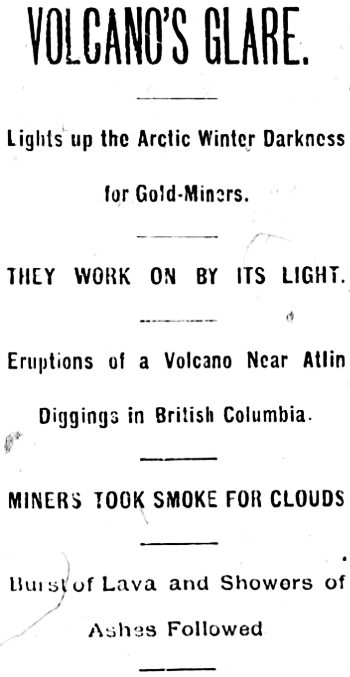
Tacoma, Wash., Dec. 2 - Further information of the active volcano discovered in the Atlin gold district in British Columbia, is to the effect that the volcano furnishes the miners a light by which to work their claims during the long darkness of the Arctic winter. The glare from the spouting lava reflecting back against
the sky, gives an almost continuous twilight to the upper end of the Atlin district.
All the passongers of the steamer Cottage City, arriving from Alaska, have stories to tell of the volcano. Dr. Kinstown of Denver says:
"The mountain in eruption is the second in the range of four towering peaks lying about fifty miles south of Lake Gladys and a slightly shorter distance from Atlin City. These mountains are all of at least 14,000 feet altitude, the crater resting a trifle below its three brother peaks.
"It was in the early part of October that the smoke was first seen issuing from the mountain. With the thought of a volcano furtherest from their minds, the
mimers attributed these first signe of eruption to clouds hanging about the peak. So constant, however, was the cloud that it became an object of daily observation from Atlin City.
"Then, on Noy. 8, the mountain burst forth in flames. Through the smoke-cloud there shot a stream of molten lava, boulders and ashes, that brightened the
sky for miles and sent its light through the darknesa down upon the men working in claims helow.
"A panic ensued among the miners when the ashes began falling upon them. The ashes fell to a depth of several inches.
"When we left the miners were working nights, profiting by the twilight
which turned night into day.
"No name has as yet been given the mountain, but when we left, the Canadian officials at Atlin were preparing an expedition to the volcane and will christen it."
On December 7th, while the story was still being widely reported, The Citizen of Ottawa, Ontario, published a one-sentence repudiation of it:
Dr. Kinsley, of Denver, repudiates the interview credited to him and sent out from Tacoma about the Atlin volcano. He says the volcano is a myth.
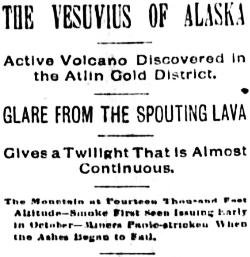
The story was too good to let go, though, and continued to be published, sometimes just as one sentence, but occasionally with wonderful headlines such as this one from the Delaware Gazette and State Journal of Wilmington, Delaware, on December 8th:
The San Francisco Call, San Francisco, California, Saturday, December 10, 1898.
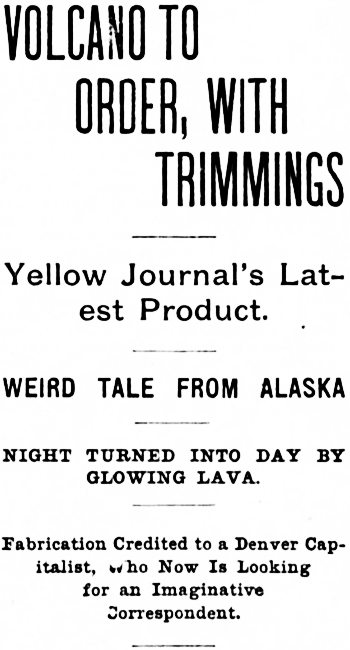
Special Dispatch to The Call.
VICTORIA, Dec. 9. - On the morning of Wednesday last the people of San
Francisco who read the Examiner were regaled with a wonderful piece of fiction-telling of the breaking out of a volcano in the Atlin country, which, in the brilliancy of its illumination, was said to rival Vesuvius. The story was told in detail and afforded scope for a column article from the pen of the imaginative Victoria correspondent of the yellow paper. In default of other and more interesting news from the north the modern Vesuvius story was made to do daily duty and was sadly overworked.
Considerable interest is taken in the fable of the smoking mountain by a
gentleman now in Victoria, for it has been circulated on the strength of his name and he is anxious to locate the enterprising news vender, who ascribes the origin of the story to him. He has no desire to cause his friends at home such poignant grief as they will be sure to experience when they find a story of such palpable extravagance associated with his name.
This gentleman is Dr. Kinsloe of Denver, who, with J. H. Jones, also of
Colorado, and Colonel Hughes of Rossland, has been spending the week in Victoria, they having arrived from the north on Tuesday last.
The story the three gentlemen have to tell does, however, deal in part with a volcano, but so far as "lava pouring from the Alaskan crest," as the Examiner has it, is concerned, they give it a most emphatic denial.
The three left Teslin some time ago and went to Atlin over an unusued Indian trail. Soon after their arrival they set out in search of the Lost Rocker mine, the secret of the location of which is said to have died with its Indian dicoverer. The information on which they made the search was given to them by an Indian, who claimed to have obtained it from his tribesman. Near the location of the lost mine a long extinct volanco was said to exist.
The two searchers found the volcano and from a thorough examination of
the crater's mouth found that it had not been active for a considerable number of years. They failed to discover any trace of the Lost Rocker.
Another imaginative correspondent, who is responsible for the story of the Atlin volcano having been given publicity, is the Tacoma correspondent of the Associated Press. He credits his news to Dr. Kinsloe, but as neither the doctor nor his associates have been in Tacoma, it seems that some ambitious sensation monger in Tacoma has elaborated the tale out of the exceedingly scanty and unsensational statement they made in reference to the so-called volcano.
Apart from its improbability in other particulars, the yarn told by the Examiner bears the stamp of impossibility upon it, for it describes in graphic language the aid which this perpetual illuminator gives the miners in operating their claims, and how they are enabled to work by the powerful light which it sheds by night as well as by
day. The fact is that the mining close season is now on in the Atlin country and the miners who cannot work by day are not likely to attempt to do so by night. Far from circulating such a story as is credited to him, Dr. Kinsloe pronounces the whole statement
false. There is no volcano, extinct or active, in the Atlin country, and the one discovered by Mr. Jones beyond Long Lake is so ancient that its last serious effort must have been concurrent with the wandering of the ten tribes.
Should Dr. Kinsloe meet the fabricator, he says, he will teach him that
volcanoes are not the only things that are active.
Despite the denial of the report, by the person said to have made the initial report, articles about the volcano continued to be published around the world through December and January. On January 15, 1899, The Kansas City Journal reprinted the following story from the New York Sun, which links the Atlin volcano to other volcanoes in the Yukon and Alaska:
The Kansas City Journal, Kansas City, Missouri, Sunday, January 15, 1899.
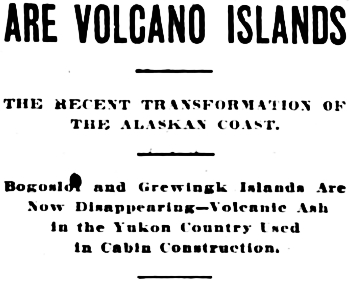
From the New York Sun.
The recent volcanic outbreak in the Atlin district, near the headwaters of the Yukon, emphasizes the fact that Alaska is a country of volcanoes as well as gold and furs and icebergs. The Pacific coast of the Americas lies along a line of weakness in
the earth's crust which is subject to disturbances from within. The South American volcanoes, extending from Terra del Fuego up through the Andes to Central America and Mexico, lie aiong this line of weakness, and connection with the Alaskan belt is made by the volcanoes of Callfornia, Oregon and Washington, which are only recently extinct.
Within the last hundred years there are authentic records of activity on the part of forty-five volcanoes in Alaska. Of these the great majority are on islands of the Aleutian group, and less than a dozen in all are on the mainland. The belt of present
volcanic activity begins on the Copper river near Mount Wrangell and extends westward to Amchitka island. Its length is 1,700 miles, or the distance from Florida to Nova Scotia. Eruptions are likely to occur at any time aiong this line, arid the whole distance is dotted with volcanic cones.
The Atlin volcano is 500 miles to the eastward of the so-called volcanic belt, and at various places in the intervening distance are evidences of volcanic action. Volcanoes have been reported in the St. Elias Alps, which in general comprise a section of
country as wild and unexplored as there is on the face of the earth to-day, and they have also been reported further north in the interior. At Fort Selkirk, where the Pelly and Lewis rivers unite to form the Yukon; the Indians tell of a burning mountain situated in the unknown region over toward the Macmillan, and the upper ramparts of the Yukon nearby are of lava rock. The Indians also tell of a great volcano at the headwaters of the White river, and for miles along the Lewis there is a deposit of volcanic ash or furnaceous sand
which shows in the cut faces of the bluffs as a beautiful white line.
The ash strata is commonly covered by a thin layer of soil, though in places it lies on the surface and the forest trees are directly rooted in it. It appears to have fallen tranquilly, much in the manner of snow deposited in a calm atmosphere. The thickness of the layer is very uniform, varying from half an inch at Caribou Crossing, near the foot of Lake Bennett, to a thickness of more than a foot just below Rink rapids. At Five-Finger rapids the ash was used by miners wintering there a year ago as a_covering for the roofs of their cabins and in some cases to fill the walls of the cabins, which were built with a double framework of small logs. The miners had been forced to go into winter quarters by the closing of the river at a time when the clay and loam soils were frozen to the solidity of rock, and as the warmth of their cabins depended in great measure upon the earth covering for the roofs, they would have fared badly had it not been
for the ash deposit, which, on account of its absolute dryness, was unfrozen and easily shoveled.
|

|
