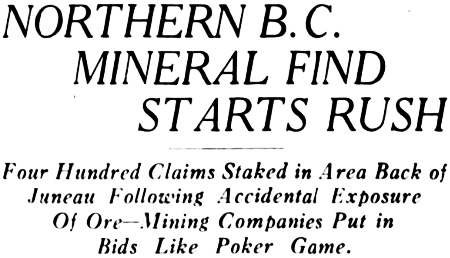
VICTORIA, Aug. 23. - A rare experience this week fell to the lot of the British Columbia minister of mines. He listened to a mining engineer, James B. Stapler, general superintendent of the United Eastern Mining Company, Los Angeles, tell a story pulsating with human interest of a new and important discovery in Northwestern British Columbia.
Mr. Stapler, be it known, is a responsible representative of one of the large mine development companies of the United States. His poise is not easily disturbed. He has examined hundreds of mine prospects and found it necessary to turn down many more than he has approved. In this case, however, he unreservedly endorsed two properties upon which relatively little development has yet been done, as meriting substantial expenditures in opening up and pronounces the whole district possessing exceptional promise in respect of mineral resources.
The district of the find is that lying back of Juneau, drained by the Taku River and its tributaries. This also is the section to which attention has been markedly directed through reports of Dr. F. A. Kerr of the Canadian geological survey.
NEW MINING DISTRICT FOUND.
Early this year Mr. Stapler went north to examine for his company a
prospect on which some underground work had been done, situated on Tulsequah River, which empties into the Taku. It was claimed that a thirty-foot vein had been exposed, sampling indicating remarkably high values in gold, silver, copper, lead and zinc. He started out in the frame of mind of the engineer on his ordinary job, and cynically not expecting to find representations altogether facts. He returns convinced that a new and important
mineral district has been found - that the property to which his company had directed him is well worth the expenditure of all that is necessary to put it on a producing basis - that another prospect has been located fully as valuable - and that the entire region is one likely to richly repay intensive prospecting.
As to the Tulsequah claims, Mr. Stapler told the minister he was agreeably surprised to find the account given by the owners substantially correct. They had not a thirty-foot vein when he checked up on the work, but subsequent work laid bare a vein twenty-five feet wide. Thus encouraged, operations were pushed ahead under his supervision. As a result 478 feet of underground tunnelling and drifting has been done, as well as considerable diamond drilling. Mr. Stapler does not wish to be quoted as to the results but they were most satisfactory.
400 CLAIMS STAKED.
All the glamor usually attaching to the unexpected discovery of fortune is associated with Mr. Sapler's description of the finding of what is known as the "Big Bull" Group of mineral claims, by a prospector named Manville. Manville was enjoying a rest by the side of a stream when, turning casually he knocked off a bit of rock to find it was heavily mineralized. Stripping it for thirty feet, he found that the same condition continued throughout. Going above and washing down the vein, it immediately became clear that his discovery was of exceptiona) importance. He wasted no time getting in his stakes and making a proper record.
The news quickly circulated and produced a stampede from Juneau. Four hundred claims have been located and many prospects, the values of which have yet to be disclosed, are being developed. A few have good surface showings.
Among those drawn to the district by the excitement were representatives
of several of the largest mine development companies. Their interest was concentrated in the Big Bull (Manville) discovery. What followed is unique in provincial mining history. Scouting engineers for mining companies of large financial resources are reputedly "hard-boiled." They have to be shown. In this case each of the engineers who inspected the Manville discovery wanted to obtain control, and was willing to stake his professional reputation by binding his principals to substantial cash payments.
The position of Manville and his associates was peculiar. The property
was for sale. The question was not of finding a buyer, but of selecting the company making the most attractive offer. They wanted as much cash as could be secured, but at the same time were so convinced of the possibilities that they also desired to retain as large an interest as possible.
BIDS LIKE POKER GAME.
Mr. Stapler explained to the minister that, after considering the position, it was agreed that the three engineers interested should sit about the table as in a game of poker, and submit their bids; that there would be no restriction as to the number of bids each company might put in; and that the offers would be opened by a disinterested party. It was one kind of poker, with the pot an absolutely undeveloped surface exposure highly mineralized, and the players trained technical men of highest qualifications, employed by some of the greatest mining corporations of the continent.
The game was played and the Alaska-Juneau Gold Mining Company, now
conducting large mining operations in Alaska, a subsidiary of one of the greatest mining corporations of the United States, was successful. The winning bid was $25,000 cash, $25,000 in six months, $25,000 at the end of the year and a 45 per cent. retained interest carried free of all charges. Among other offers was one of $36,000 cash, $36,000 at end of six months and a 30 per cent. retained interest. Another was a straight offer of $100,000
across the table for the property. Still another was that of a lease and bond with a cash payment of $50,000, and $500,000 payabie over a period of three years.
The statement is made in Jumeau that a straight offer of $1,000,000 for
the property was among the bids submitted, payable, of course, over a period of years.
It will be noted that the owners evidently have confidence in the future of their find, for they accepted the bid giving them the largest retained interest.
During the summer Mr. Stapler has had fifty men employed on the Tulsequah mineral claims and will maintain a crew of fourteen throughout the winter. The Alaska Juneau Company will employ from twenty to twenty-five on the Manville group right through
the closed season.
URGES ROAD CONSTRUCTION.
One of the problems in connection with mining development in this section is that of transportation. Mr. Stapler on behalf of his company and of the Alaska-Juneau is urging Hon. Mr. McKenzie to undertake road construction to establish immediate connection between the mining properties and Taku Arm near the mouth of the Tulsequah River. The minister has asked Dr. Mandy, resident engineer for the district, to inspect the properties and report immediately. At the same time the public works department's district engineer will look over the ground so that work may be begun without delay should the mining engineer's findings confirm reports as to the merit of the holdings under development. Early in the season some difficulty was experienced in transporting supplies from American territory into Canada. That, however, has been overcome so far as is possible. The Canadian and United States custom officials are making things as easy as
possible for the mine operators.
SUPPLIES VIA JUNEAU.
The natural difficulties, however, appear serious. Navigation on the lower reaches of the Taku is hazardous. Supplies now are forwarded to Juneau, transferred to barges and taken up the Taku, transferred again at a camp established mear the mouth of the Tulsequah, and thence placed in river boats equipped with outboard engines or which are lined up the river to the mine camp. Transportation cost has been worked out at five cents a pound, a heavy item when mining operations of considerable extent are under consideration.
The suggestion has been made that the Alaskan administration might be
prepared to construct a road from tidewater to the international boundary if British Columbia would continue from that point through the district as far as Atlin. This, however, is a matter of the future.
The mineral possibilities of the district will have to be more definitely established, Hon. Mr. McKenzie states, before the government can seriously consider the substantial outlay such a work would involve. However, the very optimistic account given by Mr. Stapler has aroused such interest that the reports of the mining engineers of the department will be expedited.