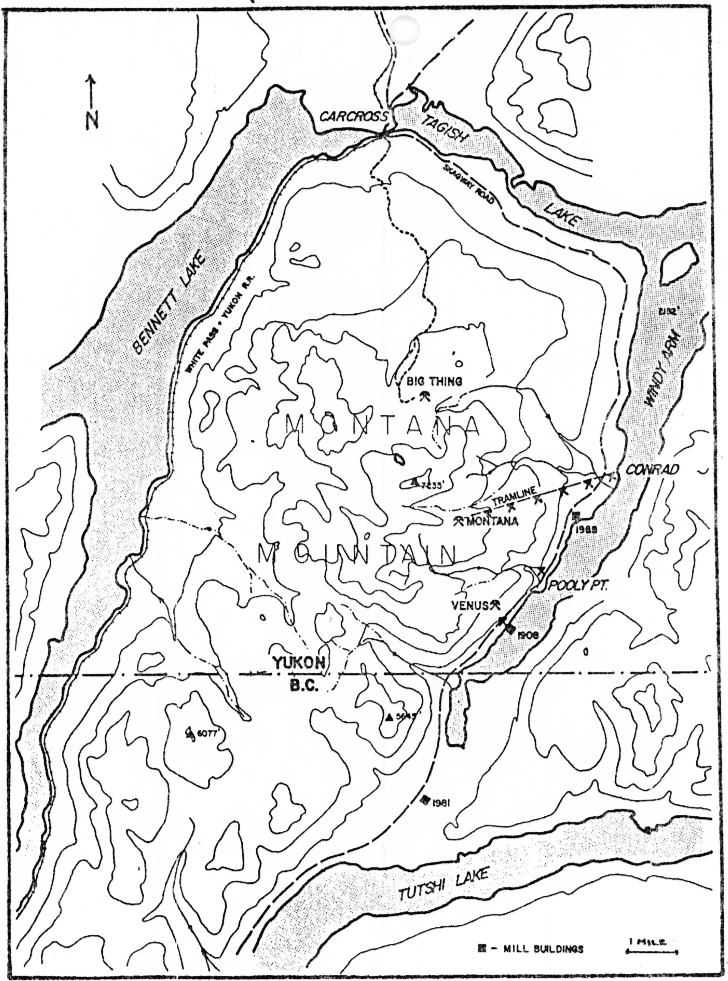
Venus Mine
Arctic & Northern Mining
Dateline: January 15, 2024.
The original 3½x8-inch folding brochure was published by United Keno Hill Mines Limited.
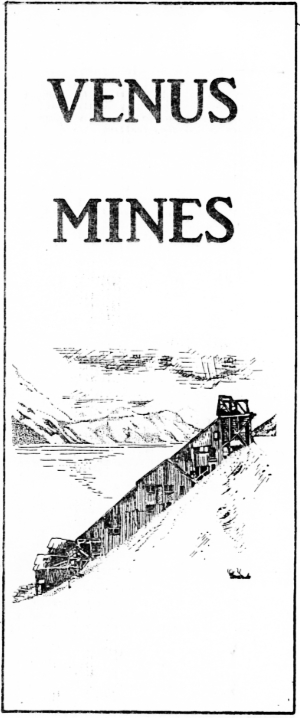
VENUS MINES
Discovery
Two young prospectors were tired; they had hunted grouse and prospected on Montana Mountain and just wanted to rest, but their dog took them on another chase. When they finally sat down and were picking at the rocks, as any prospector does instinctively, they realized it was an outcropping of silver. Jack Stewart and Jack Pooly
quickly canoed to Tagish Post to file their claims, the VENUS 1 and VENUS 2, and, formed
what became a lifelong partnership. Their discovery high above Windy Arm, at the turn of
the century, lead to the founding of Venus Mines. It became one of the first hard rock
mines in the Yukon Territory.
It was not without hardship and hard work freighting in Dawson City and Alaska, that they earned enough grubstake to return and work their claims. But, it prepared them for what lay ahead. By blasting the rockface of the mountain, they built a cliffhouse, where they spent the winter hauling ore in 100 pound sacks, laced to bull hides, to the lakeshore below. A four-horse team hauled the ore to Carcross, for shipment by rail and steamer to smelters in Washington. In time, they would see steamers on Windy Arm hauling ore and being carried down the mountain in two-bucket aerial tramways.
It became clear that hard work was simply not enough to develop the VENUS claims. A few years later, Stewart and Pooly sold to Colonel J. H. Conrad, for $120,000. When it was confirmed by telephone that the money was deposited to their bank account, the prospectors had a glorious party in Carcross. Feeling flush and in high spirits, they chartered a White Pass & Yukon Railway train from Skagway, to pick them up. Their wives, who had been promised a trip outside, were waiting in Skagway to catch the next steamer - the men arrived just in time.
Conrad
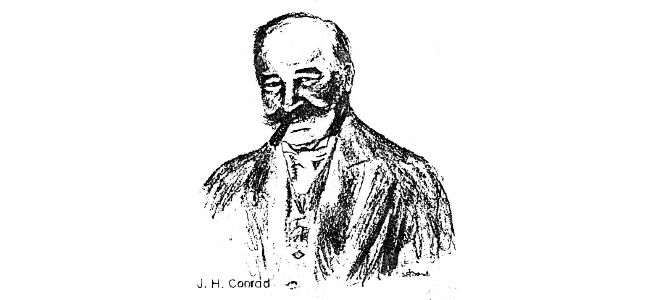
Colonel J. H. Conrad, described as a "New York financier", came from a prominent family in Montana. Big physically as well as financially, he was known to clamber over the mountains like a goat, often wearing knickerbockers. A notorious gambler and entrepreneur, Colonel Conrad spent over $750,000 total, searching for the "Big Thing", which was the name given his first mine on Montana Mountain. In today's money it would amount to millions of dollars. With the backing of well known American and Canadian names in financing and government, Colonel Conrad formed numerous companies and groups, which in turn controlled most of the important claims on the mountain.
Looking directly up Montana Mountain from the old mill, the loading terminal of the aerial tramway, used to bring ore down from the Venus mine, can be seen. At that time, there were living quarters and a compressor near the portal as well. And down along the beach is the old log, cook-bunkhouse, still firmly cabled to withstand the high, continuous winds. Pipes carried compressed air up to the mines for drills, and fresh air into the tunnels for miners, from small gasoline engines housed on the lakeshore. Assays of sorted ore from the Venus mines were reported to average between $40 and $50 a ton in silver and gold.
Completed in 1908, the old mill was the first water-concentrate, gravity mill built in the Yukon; the design was revolutionary in its day. A 100 h.p. boiler and 75 h.p. engine provided the grist for its 100 ton per day capacity. However, little ore was milled before it shut down. For one thing, there were heavy losses of silver and gold due to inefficiency; for another, Colonel Conrad is thought to have over-extended his interests by this time.
Near Pooly canyon, several aerial trauway towers are visible from the highway. The tramways, carried timbers and mining supplies, as well as miners, across the awesome canyon to the VAULT claim, one of the most forbidding locations on the mountain. A number of the mules which packed timbers up the precipitous mountain, and then down to the head of the canyon, simply never made it.
At the bottom of the canyon, a flume harnessed the creek's water power for electricity, when the seasons allowed.
The present Venus Mines' campsite is located here, on Pooly Point.
In the spring of 1905, twenty two carloads of timber were unloaded on the beach, eleven miles from Carcross. Colonel Conrad expansively leased or purchased 320 acres of land along the lakeshore to further his ambitious mining ventures. A 4-mile, double-cable aerial tramway was built from the steamer landing on the beach, to the Montana mine, over 3,000 feet above. No machinery was used for this formidable task,
only the strong backs of a 25-mule train and 50 to 60 men, at a cost of $90,000.
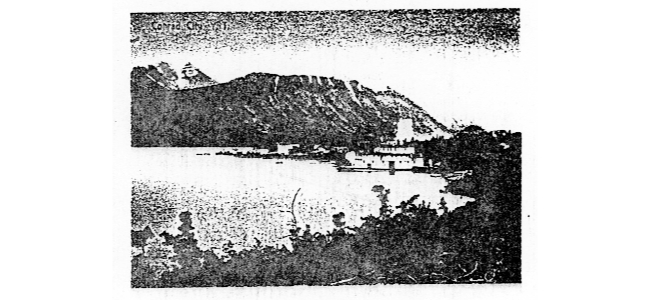
Conrad City sprang up along the lakeshore as several hotels and restaurants, barbershops, general stores, churches, laundry and bath house, tobacconist and blacksmith shops opened to serve the mushrooming population. Whitehorse Mining District was divided and the Conrad Mining District was established; subsequently a
mining recorder's office was added to the town. Soon telegraph and telephone lines were
extended, wagon roads and trails were built, and steamers made regular trips along the lake from Carcross two times a week.
And although telephone lines and trails connected the main working mines, many day-to-day difficulties were encountered due to their remote locations. On the bleak mountainside, well above treeline, stonehouses were built to accommodate cook-bunkhouses and blacksmith shops. The largest of these buildings was 100 feet by 24 feet and included an assay office. The animals which packed ore down from the mines and brought supplies back up, were sheltered nearby in frame tents. It was reported, "...supplies and wages being high, prospecting work was expensive; experienced miners were exceedingly scarce. The current wage paid is $3.50 (including board) per day of eight hours." (D.D. Cairnes, G.S.C. Sum. Rept. 1906) The same wage was paid to labourers for a ten hour day. At one point Colonel Conrad tried to raise money to build a smelter in Carcross and surveyed a further aerial tramway over the Chilkoot Pass, hoping to reduce shipping costs. But it appears that poor management also contributed greatly to the high costs.
The End of an Era
Finally, the bubble burst in 1909. Conrad City became a ghost town as quickly as it had become a boom town, only twelve people remained that year. As mines were shut down, businesses, cabins and tents were abandoned and miners moved on to other areas. Only a cabin and a portion of the tram terminus serves as a reminder of the once bustling town.
Even the 4-mile long aerial tramway served merely to carry supplies up to the mines, with waste rock providing the gravity power; the anticipated rich ore bodies of the Montana vein were never struck. From the lowest tower near the highway, five of the larger tramway towers can be seen far up the mountainside.
The more substantial buildings from Conrad City were gradually moved over the lake ice, to Carcross. The Matthew Watson General Store is one of those buildings and it has been altered very little over the years.
By 1912, Colonel Conrad's financial backers foreclosed on his developments, forcing him into bankruptcy.
In Carcross, Colonel Conrad's original log home is now owned by Willard Phelps, whose grandfather was the solicitor appointed Receiver of Colonel Conrad's assets.
Over one hundred claims were staked along Windy Arm in this era and given colourful names such as LEGAL TENDER, RUBY SILVER, BONANZA, MONTANA, MOUNTAIN HERO, BULL MOOSE AND BLACK JACK. Some of these claims, together with the VENUS claims, remain valid leases today.
The First World War took many young miners, and financiers, away from the Yukon forever, as did the sinking of "Princess Sophia", in 1918.
A New Era Begins
The Venus claims continued to be leased and mined off and on until 1923, after which all operations ceased. Not until 1966, when two Whitehorse mining engineers re-opened the mine, was any serious effort made again to mine it. J.L. Phelps and J.D. Scott had spent many years acquiring the VENUS and surrounding claims; they formed Venus Mines Limited. The company built a road from Carcross and did considerable drilling and underground work. An extravagant 300 ton per day mill was built but operated only briefly
before closing due to lack of capital, stringent environmental requirements and flat prices, in 1971.
The main VENUS claims were transferred to another syndicate, and in 1979 United Keno Hill Mines Limited, operators of Yukon's oldest silver mine, optioned all of the properties. The company carried out geological and geochemical work and in 1981, built a 100 ton per day mill, seven miles south of the Venus Mines. Production was deferred however, due to low silver and gold prices. In 1984, a further extensive exploration program was launched, both underground on the Venus vein and drilling from the surface to investigate other veins. Thus, once again, Venus Mines breathes with new life.
* Courtesy of United Keno Hill Mines Limited *
* The assistance and advice of John D. Scott, Douglas Smith & "Dutch" Van Tassell; UKHM
colleagues: Dennis Prince, Ken Watson & Jim McFaull is gratefully acknowledged. *
Copyright © 1985 by United Keno Hill Mines Limited/S.R. Ford. All rights reserved. No
part of this pamphlet may be reproduced in any form without written permission of the authors.