A Guide to the Dempster Highway
Dateline: February 11, 2025.
1 Service Battalion: Duty Above All
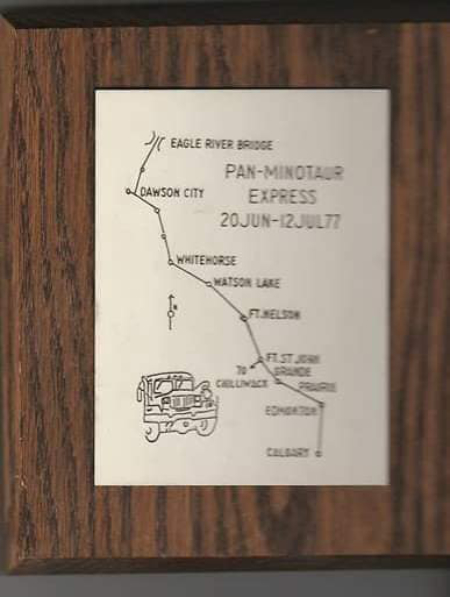
Pan-Minotaur Express Operation
Eagle River Bridge Redeployment
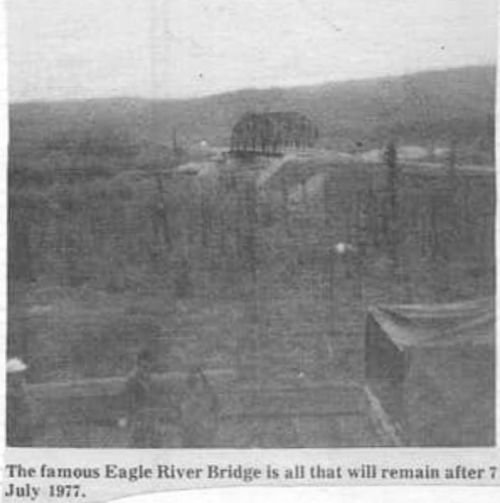
During the past year 1 Combat Engineer Regiment, formerly 3 Field Engineer Squadron, based in Canadian Forces Base Chilliwack, has been actively engaged in the construction of a bridge over the Eagle River in the Yukon Territory. Construction was
completed on 27 June 1977. The bridge is the longest and largest of its type ever attempted by a Canadian military engineering unit.
1 Service Battalion has provided service support to the Engineers throughout the construction period. Sergant Al Mick has been located at Whitehorse, Yukon for the duration of the construction period and has held the post of "Expeditor." He has been their primary contact with 1 Service Battalion for all service support requirements. Now that the project is completed. Sgt Mick will tear himself away from Whitehorse with abnormal reluctance and return to Calgary.
Three days after the Battalion's return from Exercise WAINCON '77, the
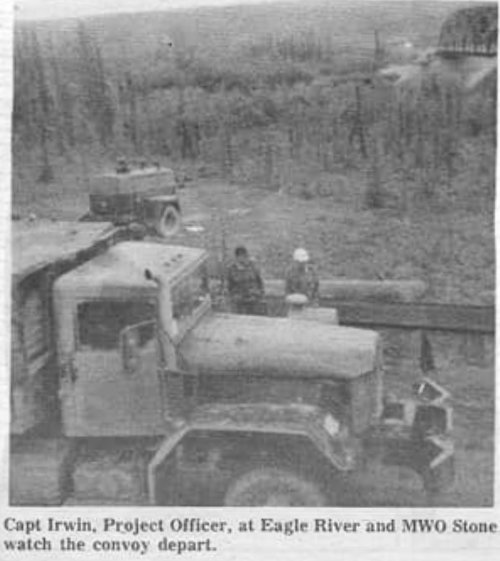
Operation Eagle River Bridge Redeployment convoy was ready to depart. Under the watchful eyes of Lieutenant Colonel R. G. Dauphinee, Commanding Officer 1 Service Battalion, Maj. G. Tousignant, DCO 1 Svc Bn, and Maj. G. Reinhardus, OC Tn Coy, the 37 vehicle convoy departed at 0630 hrs 20 Jun 77 for the North.
All 74 members of the convoy were eager to be on their way. As a matter of fact, the anticipation of this operation was a major morale-building factor that
sustained high spirits throughout Exercise WAINCON '77.
Operation Eagle River Bridge Redeployment or, more appropriately, the
PAN-MINOTAUR EXPRESS, was essentially a transport operation. However, to ensure maximum effectiveness several units were involved. 1 Military Police Platoon provided three teams who were responsible for signing the route, halt areas and controlling traffic at key
points. In addition they provided liaison as required with the RCMP en route.
1 Field Ambulance provided an ambulance with medical assistant and
driver. Sgt "Doc" Anderson proved to be a trucker at heart and soon gave up his full-time pill-pushing to be a part-time dispatcher. The only thing he didn't give up was his comfortable 1¼ Ton accommodations.
While Transportation Company provided the majority of the drivers and
vehicles from their field transport resources, Maintenance and Administration Companies
came through with vehicle technicians, cooks and drivers. In the end, everyone turned out to be drivers and mechanics responsible for their own vehicles. In general, everyone, regardless of their unit or company affiliation, threw themselves wholeheartedly into the task and became loyal to the convoy. It was due to this co-operation and enthusiasm that the convoy was a 74 member team with a common goal - Eagle River or bust!!
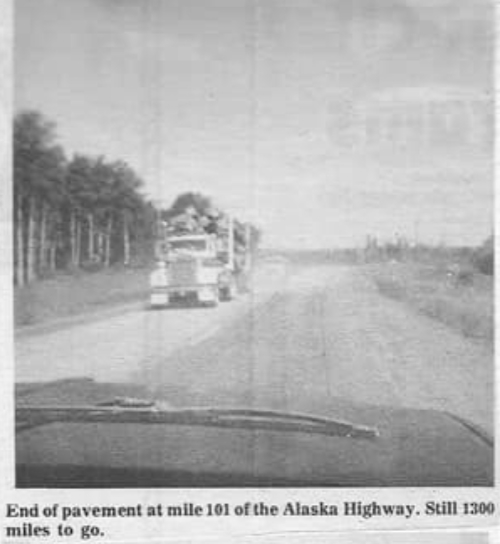
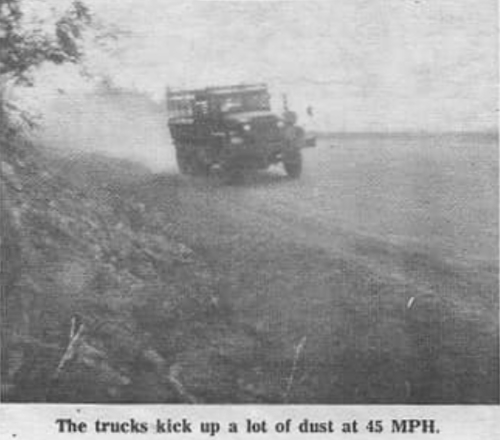
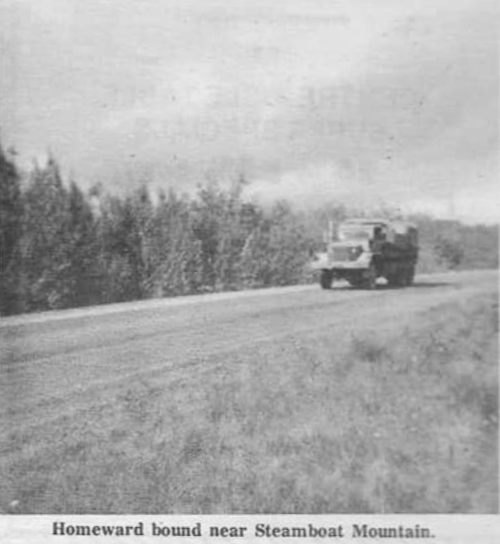
The convoy travelled approximately three hundred miles each day at an
average speed of 45 to 50 MPH. Overnight stops were made at Whitecourt, Alta., Fort St. John, B.C., Fort Nelson, B.C., Watson Lake, Y.T., Whitehorse, Y.T., Dawson City Y.T., Ogilvie River Y.T. and, finally, the Eagle River Bridge Site. By this time the convoy was
parked about 15 miles from the Arctic Circle and a day's drive, if the road was completed, to Inuvik, N.W.T.
While on the bridge site the members of the convoy were treated royally by the engineers. Two vehicles were loaded and serviced on the afternoon of our arrival
in order to transport loads to Whitehorse for shipment by air. On 29 June 77 the remainder, for the most part, of the vehicles were loaded under the supervision of MCpl Jim Mutlow. As a matter of fact, we loaded in a single day the stores and equipment that the engineers thought would take two or more days to load.
For the next two days tires were repaired, all vehicles received grease jobs and any badly-needed repairs. However, a "volunteer" work party assisted the engineers in moving 45 gal drums of Diesel from their scattered locations in the tundra to an orderly stock-pile on hard standing. This bullwork was completed very quickly and efficiently. To demonstrate their gratitude the engineers kindly treated us to a Happy
Hour that was enjoyed by all.
Finally the morning of 2 July arrived and we were ready to depart the site. For three and a half days everyone had been waiting for clear, sunny weather so
that photos could be taken of this famous bridge. Fortunately, on the morning of 2 Jul, some photos were taken, despite the lightly-falling snow. At 0800 hrs we left - heavily loaded.
One section, under the command of MCpl "Cam" Cameron, composed of five 5
Ton trucks and a 5 Ton tractor trailer, remained on the site to load last-minute items. They accompanied the Engineer Road Party to CFB Chilliwack before returning to Calgary on 17 July.
In all, twenty-one 5 Ton trucks, 1 tractor trailer and two tilt-bed trailers were loaded for the return trip.
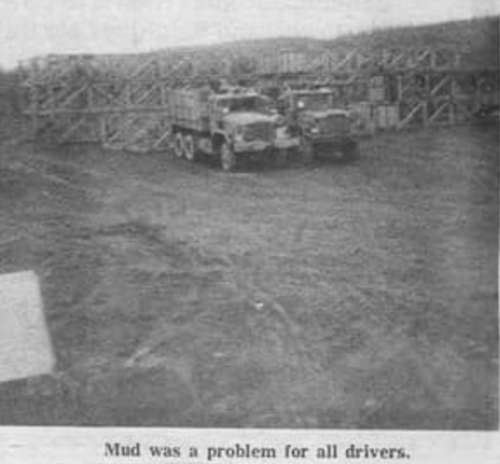
The return trip proved more eventful than the deployment. More vehicles
suffered from flat tires than on the way up. Every evening the drivers asked, "Why is the flat always on the inside dual?" However, diligent vehicle inspections continued and many
mechanical problems were avoided.
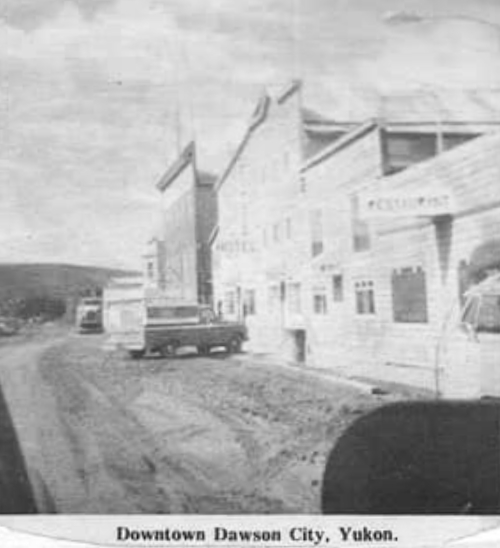
Needless to say a little enjoyment and fun was mixed in with all this hard work. While in Dawson City, Yukon, most people visited the local tourist attractions
including Diamond Tooth Gertie's Gambling Casino, the Can-Can Dancer show at the Gaslight Follies and inspected the swinging doors of the Sourdough Saloon of the Downtown Hotel. With its mud streets and wooden board walks, Dawson lacked only the lonely prospectors
on their burros to be the same as it was eighty years ago.
Whitehorse is an active town. On our return it was pouring rain. Not being made of sugar, the convoy baseball team made its way to the baseball diamond for a
softball game against the girls from the Klondike Inn and the Kopper King. MCpl Jim Mutlow's moosemilk was thoroughly enjoyed by all involved in the mud-ball game.
In Watson Lake, Yukon, the mudball game was repeated with another girl's
team. MCpl "Ruth" Gillies and Lt "Kathy" Bulpit traded places on the teams and played for the girls team. This made things more fair and much more interesting. However the convoy team came through again and maintained their undefeated record. Naturally, both teams adjourned for a couple of celebration drinks after the game. A good time was had by all.
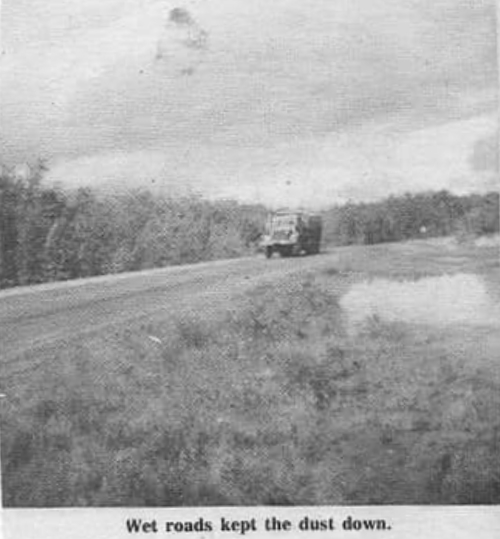
In retrospect, the operation was a major success from all viewpoints. The Battalion's drivers have gained immeasurable experience in driving on gravel roads in all weather conditions for extended periods of time. The vehicles returned in better mechanical condition than they were in when they departed. There are now experienced mechanics and drivers on our two newest equipment acquisitions - the 1¼ ton truck and the M809 five Ton Standard Military Pattern Diesel Truck.
In addition, a military presence has been established in the North, if
only for a brief time. Also some good public relations have been made and the northern population is looking forward to our return.
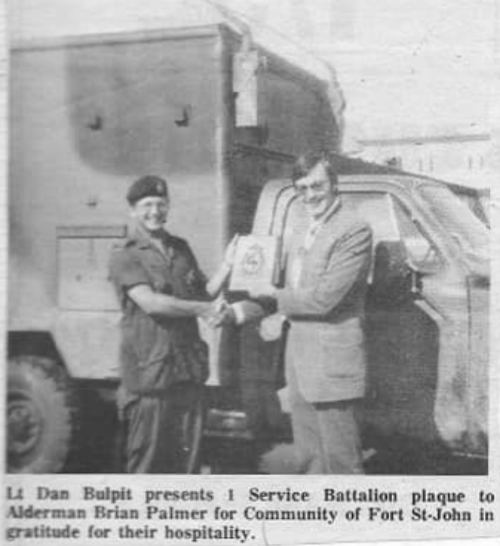
1 Service Battalion unit plaques were presented by Lt Dan Bulpit, Convoy
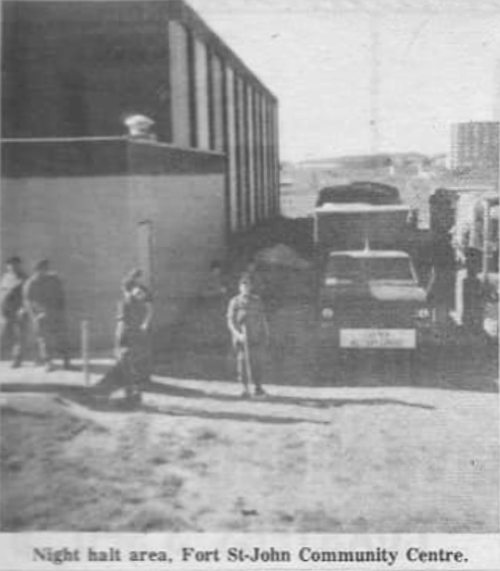
Commander to the Communities of Dawson City, Whitehorse, Fort Nelson and Fort St. John in gratitude for their hospitality. In each community the convoy was provided accommodation
and parking facilities at no expense in either school auditoriums or community centres. In each town we have been invited to return and again make use of their facilities if convenient with our plans.
In total, the convoy accumulated 210,000 miles and consumed 5,730 gallons of gas and 18,000 gallons of diesel fuel at a cost of approximately $15,300.00. This
operation has been the longest single road move attempted by 1 Canadian Brigade Group and 1 Service Battalion. It is undoubtedly the longest move of this magnitude attempted by the
Canadian Armed Forces in many years.
The PAN-MINOTAUR EXPRESS has been good training, good fun and a huge
success. It provided an opportunity to examine our new vehicles and gain valuable experience with them over various types and conditions of roads. The operation was extremely successful in all respects but the most important aspects were that a real job was done in a professional manner while everyone enjoyed themselves immensely. Until the next task of this kind, "keep on truckin".
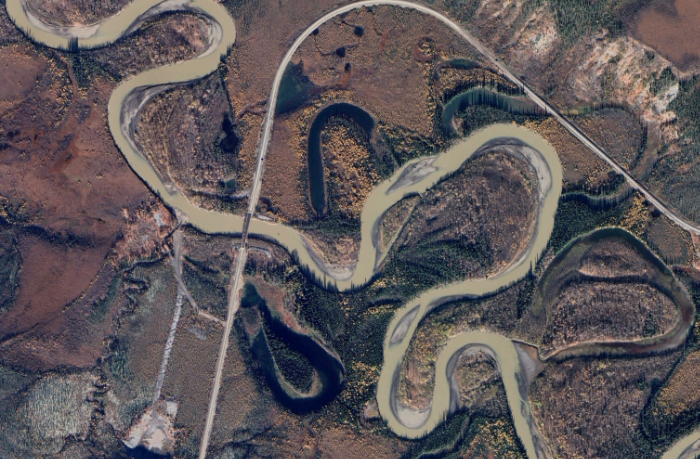
Click on the Google Earth image of the Eagle River Bridge location below to go to the interactive version in Google Maps, to continue your exploring.